By Mohsin Rabnawaz, founder of SKIMZO
Forklift operator jobs typically pay $16 to $20 or more an hour. Certification requires OSHA-compliant training plus a hands-on employer evaluation, not just an online course, contrary to what many certification vendors imply. Certification lasts 3 years and applies only to the forklift type trained on.
Most guides on this topic are written by companies selling certification courses, and they conveniently leave out a detail that could cost you real money and a wasted application. I dug into what OSHA actually requires, separate from what certification vendors advertise, and worked out where real hiring realities differ from the easy “get certified in an hour” pitch.
The Certification Misconception That Could Cost You
This is the single most important thing to understand before you pay for anything.
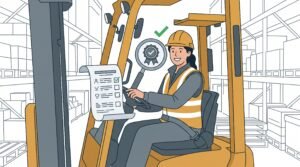
OSHA does not issue forklift certification directly. The agency requires employers to certify their own operators after delivering compliant training under regulation 29 CFR 1910.178. Many online certification vendors sell “OSHA-approved” cards, but that phrase is misleading. A third-party card alone does not satisfy the OSHA standard unless your employer also conducts a hands-on, site-specific evaluation on the actual equipment you’ll use at that specific workplace.
I’d treat an online-only course as step one, not the finish line. If a certification vendor implies you’ll be fully job-ready after watching videos and passing a quiz, that’s not the full picture. The hands-on evaluation piece has to happen with an employer, on real equipment, before you’re actually compliant.
What Certification Actually Requires
Understanding the real process helps you avoid wasting money on something that doesn’t fully qualify you.
Full certification requires formal instruction, which can be completed online, in a classroom, or through video, combined with a hands-on practical evaluation conducted by a qualified person, usually your employer. Certification must be renewed every 3 years, or sooner if you’re involved in an accident, observed operating unsafely, or assigned to a new type of equipment. Operators must be at least 18 years old.
Here’s a detail that trips people up. Certification is type-specific. If you trained and were evaluated on a sit-down forklift, that certification doesn’t automatically cover a reach truck or a clamp truck. Those require separate training on the specific equipment.
| Requirement | Standard |
|---|---|
| Minimum age | 18 years old |
| Formal instruction | Online, classroom, or video-based |
| Hands-on evaluation | Required, conducted by employer on actual equipment |
| Recertification | Every 3 years (or sooner after incident/new equipment) |
| Coverage | Type-specific, not universal across all forklift classes |
Forklift Classes: What Certification Actually Covers
Since certification is type-specific, it’s worth knowing the formal equipment categories OSHA recognizes before you enroll in a course.
| OSHA Class | Equipment Type | Common Setting |
|---|---|---|
| Class I | Electric motor rider trucks (sit-down) | Warehouses, distribution centers |
| Class II | Electric motor narrow-aisle trucks (reach trucks) | High-density storage warehouses |
| Class III | Electric motor hand trucks (pallet jacks) | General warehouse, retail backrooms |
| Class IV/V | Internal combustion engine trucks (cushion/pneumatic tires) | Outdoor yards, construction, manufacturing |
| Class VI | Electric/IC engine tractors | Towing, tugger applications |
| Class VII | Rough terrain forklifts | Construction sites, outdoor lumber yards |
A “forklift operator jobs” search on a general board pulls in postings with wildly different actual requirements, and reading past the job title matters more than it does in most fields.
Some forklift operator jobs are standalone roles focused purely on equipment operation, common in large distribution centers with dedicated forklift teams. Others bundle forklift duties into a broader warehouse associate role, where you’ll operate equipment part of the shift and handle picking or packing the rest. Pay and required experience often track this distinction closely, with standalone forklift operator jobs typically paying more but expecting more documented equipment experience upfront.
How Much Do Forklift Operator Jobs Actually Pay?
Real job postings give a clearer picture than aggregated averages for this specific role.
Current postings commonly show pay in the $16 to $20 or more an hour range for forklift operator jobs. Experienced or specialized operators, particularly those running heavy-duty equipment over 25,000 pounds, tend to earn toward the higher end. Here’s a calculation worth seeing. At $18 an hour full-time, that’s 18 × 40 × 52 = $37,440 a year, before overtime or any shift differential.
I’d treat this range as a realistic starting point rather than a ceiling. Operators with clamp truck or reach truck experience, or those willing to work less popular shifts, commonly see offers above this baseline.
Do Forklift Operator Jobs Really Require No Experience?
This is where marketing and hiring reality genuinely diverge, and it’s worth knowing before you apply broadly.
Certification itself requires no prior experience. But many actual job postings for “Forklift Operator” specifically ask for 1 to 2 years of prior forklift experience, which creates a real chicken-and-egg problem for someone newly certified. Some postings explicitly state “training provided” or “certification a plus but not required,” while others firmly require documented experience.
I’d apply broadly and read postings carefully rather than assuming certification alone opens every door. Postings that mention training provided or list certification as a plus, rather than a strict requirement, are your realistic entry point as a newly certified operator.
What Different Forklift Equipment Actually Involves
Not all forklift jobs use the same equipment, and knowing the differences helps you understand what a specific posting is actually asking for.
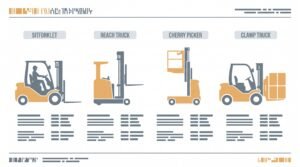
Sit-down forklifts are the most common and typically what beginner certification covers first. Reach trucks operate in narrower warehouse aisles and require separate training. Cherry pickers lift operators to retrieve items from high shelving, and clamp trucks use specialized attachments to grip and move non-palletized loads like paper rolls or appliances. Pallet jacks, both manual and electric, are simpler equipment some postings group under the same “material handling” umbrella.
Where to Actually Search for Forklift Operator Jobs
Beyond general job boards, a few specific channels show up repeatedly as real hiring paths for this role.
Staffing agencies specializing in industrial and logistics placement, including Aerotek and Randstad, actively place forklift operators and often have faster turnaround than direct applications to individual employers. Forklift operators aren’t limited to warehouses either. Construction sites, manufacturing facilities, and freight/transportation companies all hire for this role, which widens your search considerably beyond typical warehouse job boards.
If you’re weighing this against other warehouse entry points more broadly, I’ve covered warehouse jobs near me in a separate guide. It includes how forklift certification compares to other entry-level roles in that setting.
How I Checked These Numbers
I want to be upfront about how I approached this. Certification-vendor sites dominate the search results for this topic, and most have an obvious incentive to downplay the online-only limitation.
I cross-referenced the OSHA certification requirements against multiple independent compliance-focused sources, specifically looking for ones that explained the employer-evaluation requirement clearly rather than glossing over it. For pay data, I looked at actual current job postings rather than aggregator averages, since this gave a more accurate picture of what employers are offering right now.
The Short Version
Forklift operator jobs pay $16 to $20 or more an hour. OSHA doesn’t issue certification directly, and an online-only course alone doesn’t fully satisfy the standard, since employer-conducted hands-on evaluation is also required. Certification lasts 3 years and only covers the specific forklift type trained on. Despite being marketed as entry-level, many job postings ask for 1 to 2 years of experience, though some explicitly offer training. Different equipment types, from sit-down forklifts to reach trucks and clamp trucks, require separate training. Staffing agencies and industries beyond warehousing, including construction and manufacturing, are worth searching beyond typical job boards.
Frequently Asked Questions
Is an online-only forklift certification actually valid for a job?
Not fully on its own. OSHA requires formal instruction, which can be completed online, plus a hands-on practical evaluation conducted by your employer on the actual equipment you’ll use at that specific workplace. An online certification card alone doesn’t satisfy the full OSHA standard for forklift operator jobs, so treat it as only the first step, not complete job-ready certification.
How much do forklift operator jobs actually pay?
Current job postings commonly show pay in the $16 to $20 or more an hour range for forklift operator jobs. Experienced operators or those running heavy-duty or specialized equipment tend to earn toward the higher end. At $18 an hour full-time, that works out to roughly $37,440 a year before overtime, though specific pay still varies by location, industry, and equipment type.
Do forklift operator jobs really require no experience?
Certification itself requires no prior experience, but many actual job postings for forklift operator roles ask for 1 to 2 years of prior experience, creating a real gap for newly certified applicants. Some postings do explicitly offer training or list certification as a plus rather than a strict requirement, so reading postings carefully matters more than assuming certification alone guarantees an interview.
How long does forklift certification last?
Certification lasts a full 3 years under OSHA’s standard, though it must be renewed sooner if an operator is involved in an accident, observed operating unsafely, or assigned to a genuinely new type of forklift equipment entirely. Certification is also type-specific, meaning training completed on one forklift class doesn’t automatically cover other equipment types like reach trucks or clamp trucks.
Where should you actually search for forklift operator jobs?
Beyond general job boards, staffing agencies specializing in industrial and logistics placement, including Aerotek and Randstad, actively place candidates for forklift operator jobs and often move noticeably faster than direct applications to individual employers usually do. Forklift operators also work outside warehouses, including construction sites and manufacturing facilities, which genuinely widens the realistic search beyond typical warehouse-focused job listings alone.




One Comment on “Forklift Operator Jobs 2026: The Certification Warning”