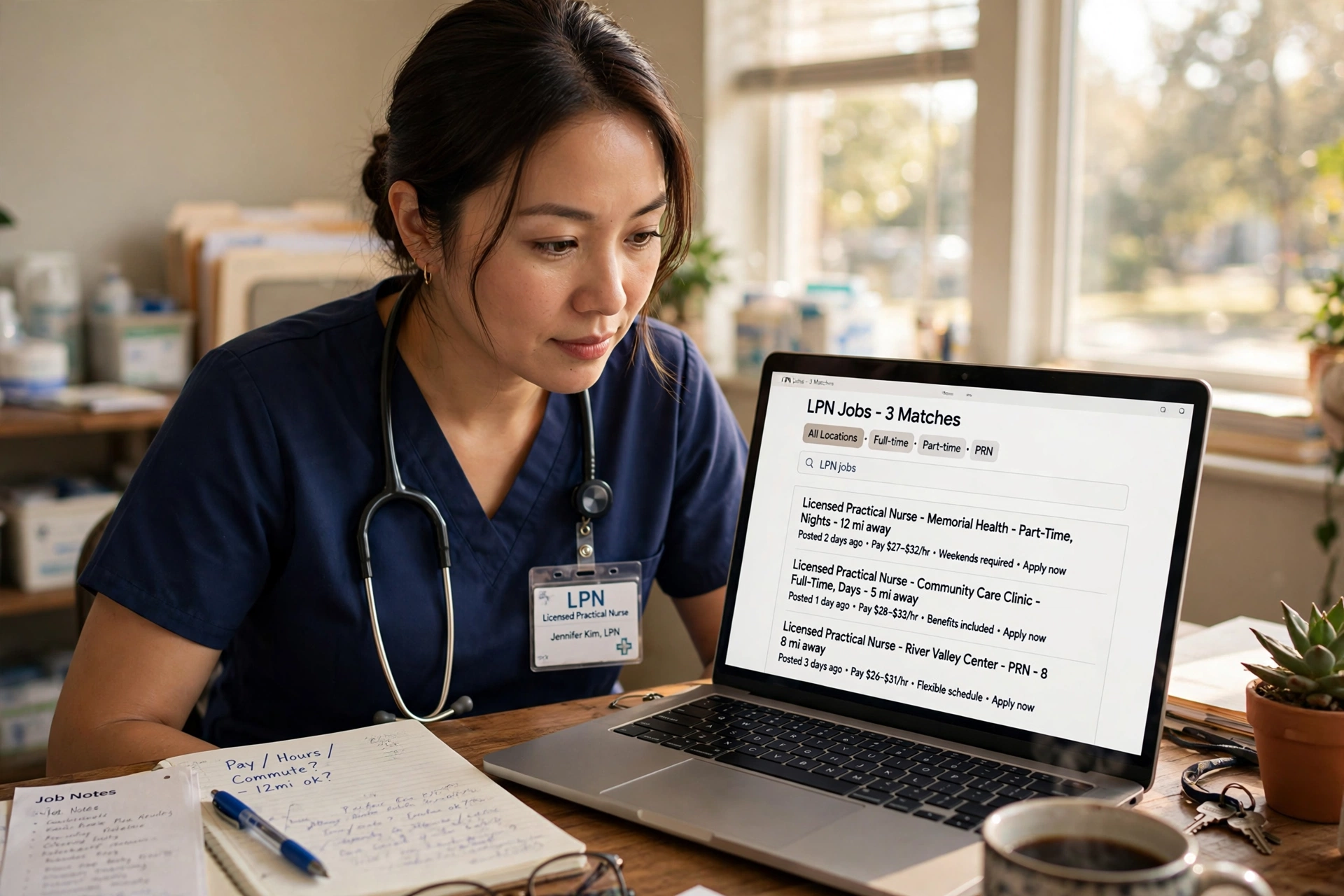
LPN jobs near me means licensed practical nurse openings within driving distance of your home, most often in nursing homes, home health, hospitals, and clinics. You need a state-approved program of about one year, a state license, and a passing NCLEX-PN score to apply today.
Most job boards show you a long list of openings. They do not tell you which ones fit your license, your schedule, or your pay target. I see the same problem in my own research work.
I check job data every day, and I have noticed that the top listings often hide the details that matter most. This guide fixes that gap. It gives you real pay numbers, real settings, and a clear path from training to a signed offer.

What LPN Jobs Near Me Really Means
The phrase sounds simple. It hides three checks you must pass. First, the job must sit within a drive you accept.
Second, your license must cover that state. Third, the role must sit inside your legal scope of practice. A job that fails any one of these three checks wastes your time.
Quick answer: What does LPN stand for?
LPN stands for Licensed Practical Nurse. In Texas and California, the same role is called Licensed Vocational Nurse, or LVN. LPNs give basic medical care under the direction of a registered nurse or a physician.
They take vital signs, give medications, change dressings, collect lab samples, and record patient progress. They do not build care plans alone, and they do not make independent clinical calls. That supervised role is the legal core of the license in every state.
Most openings cluster near people who need daily care. That is why nursing homes post so many LPN roles. Home health agencies post many more. Hospitals post fewer LPN roles, and clinics post steady daytime roles.
I compared board listings with Bureau of Labor Statistics data while writing this guide. The pattern matched in both sources. Care follows older adults, and LPN work follows care.
What LPNs Do Day to Day
An LPN shift runs on routine, watchfulness, and clear notes. You start by checking your assigned patients. You take vital signs and note any change. You give medications on schedule.
You change dressings and check wounds. You help patients move, eat, and stay comfortable. You write down what you see, and you report any change to the supervising nurse.
Here are the core duties you will see in most postings:
- Take and record vital signs, symptoms, and general condition
- Give oral, injected, and other routine medications as ordered
- Change dressings, care for wounds, and insert or manage catheters
- Collect samples for lab tests and help with basic procedures
- Watch patients for change and report it to the RN or physician
- Keep clear, timely notes in the patient record
- Support and guide nursing assistants on daily tasks
- Teach patients and families basic home care steps
The charge-nurse role surprises many new LPNs. In long-term care, LPNs often run a unit on a shift. They manage medication passes, guide aides, and keep the floor steady.
I have noticed that job ads for nursing homes stress leadership and calm judgment for this reason. The work is hands-on, and the shift moves fast.
Where LPN Jobs Are Hiring Right Now
Nursing and residential care is the largest employer of LPNs by a wide margin. Hospitals come next. Home health and physician offices follow close behind.
The table below uses Bureau of Labor Statistics 2025 data. It shows where the jobs sit.
The openings in LPN jobs near me follow the same pattern, with nursing homes leading.
| Work setting | Share of LPN jobs |
|---|---|
| Nursing and residential care facilities | 37% |
| Hospitals, state, local, and private | 16% |
| Home healthcare services | 12% |
| Offices of physicians | 11% |
| Government, excluding state and local education and hospitals | 6% |
The remaining share sits in smaller settings. Those settings include schools, rehab centers, hospice care, correctional facilities, and outpatient clinics. Together they hold about 18% of LPN jobs. I worked out that figure by adding the five shares above, which total 82%, and subtracting from 100%.
Quick answer: Where do LPNs work most often?
LPNs work most often in nursing and residential care facilities, which hold 37% of all LPN jobs. Hospitals hold 16%, home health holds 12%, and physician offices hold 11%, based on Bureau of Labor Statistics 2025 data. That spread tells you where to search first.
If you want the most openings near your home, start with nursing homes and home health agencies. Hospitals hire LPNs too, but they hire fewer of them, and their LPN roles are narrower.
Demand looks steady, not explosive. The Bureau of Labor Statistics projects LPN employment to grow 3% from 2025 to 2035. That growth is about average for all jobs.
About 51,800 openings per year are projected over that decade. Most openings come from workers who retire or move to other roles, not from new positions alone. I read that as a stable market with constant turnover, which keeps local hiring active.
Job boards back up the scale. At the time of writing, Indeed listed about 62,000 LPN jobs in the United States. ZipRecruiter showed LPN roles across a headline band of $24 to $40 per hour.
Those board counts move daily, so treat them as a snapshot. The BLS figures are the stable base.
LPN Pay: What the Numbers Show
Pay is the first question most readers ask. The national median gives you the anchor. The Bureau of Labor Statistics reports a median annual wage of $64,400 for LPNs and LVNs in May 2025. That equals $30.96 per hour.
The bottom 10% earned about $49,740 per year. The top 10% earned about $83,440 per year. Your own pay will sit inside that band based on state, setting, shift, and years on the job.
State pay gaps are large. The table below uses BLS mean annual wages reported by Nursa. Mean pay runs higher than median pay, so these figures sit above the $64,400 median.
| State | Mean annual wage |
|---|---|
| Washington | $79,970 |
| California | $79,090 |
| Oregon | $78,160 |
| Alaska | $77,850 |
| Rhode Island | $77,240 |
| Mississippi | $49,960 |
| Alabama | $50,760 |
Washington pays about $30,010 more per year than Mississippi on this mean measure. I worked out that gap as $79,970 minus $49,960, which equals $30,010. Living costs differ by state too.
A high wage in a high-cost state may buy less than a mid-range wage in a low-cost state. Compare pay with rent, travel, and taxes before you rank states.
Quick answer: How much do LPNs make per hour?
LPNs earned a national median of $30.96 per hour in May 2025, based on Bureau of Labor Statistics data. That equals $64,400 per year for full-time work. The bottom 10% earned about $23.91 per hour, and the top 10% earned about $40.12 per hour.
Night and weekend shifts often add $2 to $3 per hour in real postings. Sign-on bonuses also appear in many ads, with examples from $1,500 to $10,000 for full-time roles.
Now the worked example. Take the median hourly rate of $30.96. Work a 36-hour week, which is common in nursing.
Step 1: 36 hours x $30.96 = $1,114.56 gross pay per week.
Step 2: $1,114.56 x 52 weeks = $57,957.12 gross pay per year.
Step 3: Add a $2.00 night differential. New rate: $30.96 + $2.00 = $32.96 per hour.
Step 4: 36 hours x $32.96 = $1,186.56 per week.
Step 5: $1,186.56 x 52 weeks = $61,701.12 gross pay per year.
The night differential alone adds $3,744.00 per year. I worked that out as $61,701.12 minus $57,957.12, which equals $3,744.00. Taxes, benefits, and overtime change the take-home figure. The maths still shows why shift choice matters as much as base pay.
Setting also moves pay. Nursing care facilities tend to pay near the top of the LPN band. Physician offices tend to pay less but offer steadier daytime hours.
Home health sits in the middle on hourly pay but often pays per visit or per case. I compared these patterns across BLS setting data and live postings. The order held in both.
When you compare LPN jobs near me, weigh the setting against the shift and the commute.
How to Become an LPN: Program, Exam, License
The path to an LPN license follows a set sequence. First, you finish a state-approved practical nursing program. These programs take about one year full-time, and many run 12 to 18 months.
Community colleges and technical schools run most programs. Coursework covers fundamentals, anatomy and physiology, pharmacology, and clinical practice.
Tuition is listed as NOT AVAILABLE here. I could not find a verified national total from a primary source. Ask each school for tuition, fees, books, uniforms, and exam costs before you enroll.
Second, you apply to your state board of nursing. The board checks your transcripts and your background. Rules vary by state, so a program approved in one state may not meet another state’s rules.
Third, you pass the NCLEX-PN exam. This computer-adaptive test measures clinical judgment. It asks what to report, what to recheck, and what to do first within your scope.
Fourth, you receive your license and start applying to LPN jobs near me. The Nurse Licensure Compact lets a compact license work in other member states. Check your board before you take a travel role.
Some states add an IV therapy certification after licensure. Check your state board for the exact rule in your state.
Quick answer: How long does it take to become an LPN?
It takes about one year of full-time study to become an LPN, and many programs run 12 to 18 months. After that, you apply to your state board and sit the NCLEX-PN exam. The first-time pass rate for US-educated candidates was 79.1% in 2024, based on NCSBN data reported by Osmosis.
Exam prep should focus on thinking, not memorization. Drill priority questions, drug classes rather than single drugs, and practice picking the one step that keeps the patient safe first.
LPN vs RN: Which Path Fits You
LPN and RN roles look alike on the surface. The difference is clinical authority. LPNs carry out care plans. RNs build and change them.
| Factor | LPN | RN |
|---|---|---|
| Program length | About 1 year, 12 to 18 months | 2 to 4 years, associate or bachelor’s degree |
| Licensing exam | NCLEX-PN | NCLEX-RN |
| Scope | Basic care under RN or physician direction; carries out care plans | Full assessment, care plans, and independent clinical judgment |
| Common settings | Nursing homes, home health, clinics, physician offices | Hospitals, clinics, schools, telehealth |
| Supervision | Works under an RN or physician | More autonomy; supervises LPNs and aides |
Quick answer: What is the difference between an LPN and an RN?
The main difference is clinical authority. LPNs carry out care plans under RN or physician direction. RNs perform full assessments, build and change care plans, give all medication classes, and supervise LPNs and aides. RN training takes 2 to 4 years, while LPN training takes about one year. RNs earn more, while LPNs start work sooner and can bridge later.
The LPN-to-RN bridge lets working LPNs earn credit for prior coursework. Hospital, ICU, and ER roles usually require an RN. The LPN route is a faster door into nursing. The RN route opens more doors later. The choice is about timing, not talent.
How to Find and Win LPN Jobs Near Me
A five-step method beats a scattergun search. Follow these steps in order.
- Step 1: Set your radius and pay floor. Pick a drive you will accept, such as 30 minutes. Set a minimum hourly rate. Skip any posting that hides pay below your floor.
- Step 2: Search the big boards with a tight query. Search “LPN” plus your town or ZIP code on Indeed and ZipRecruiter. Use filters for full-time, part-time, and per diem work. Save the search so new posts reach you.
- Step 3: Go direct to local employers. Check the career pages of nursing homes, home health agencies, and clinics near you. Call the nurse recruiter. Many local roles never reach the big boards.
- Step 4: Check license fit. Confirm the state, the scope, and the shift before you apply. A great job in the wrong state wastes your time.
- Step 5: Apply fast with a tailored resume. Match your resume to the duties in the posting. Name the setting, shift, and skill you offer. Add a short cover note, your license number, your BLS CPR card, and your earliest start date.
Interview prep is simple. Prepare one short story for each topic: medication safety, a patient change, and teamwork. For each story, say what you saw, what you did, and what happened.
Watch for red flags. A posting that pays far above the local band but names no setting is suspect. Any job that charges fees to apply is suspect. A recruiter who will not name the facility is suspect. Real employers name the site, the shift, and the pay band.
Related roles on Skimzo
If you are weighing nursing support roles, these Skimzo guides help. Our hospital CNA jobs guide covers the aide role that works beside LPNs on most floors. Our pharmacy technician jobs guide covers a second clinical support path with shorter training. Our healthcare administrator salary guide shows where management pay sits above bedside pay.
The Short Version
LPN jobs near me means local openings for licensed practical nurses in nursing homes, home health, hospitals, and clinics. Median pay was $64,400 per year, or $30.96 per hour, in May 2025. Training takes about one year, plus the NCLEX-PN exam and a state license.
Nursing homes hold the most jobs at 37%. Search with a set radius, a pay floor, and a license check, then apply fast to the best fits.

Frequently Asked Questions
Do LPN jobs near me require a degree?
No. LPNs do not need a college degree. You need a state-approved practical nursing program, which takes about one year full-time, plus a state license and a passing NCLEX-PN score. Community colleges and technical schools run most programs. A degree helps if you later bridge to RN, but it is not required to start as an LPN.
Can new graduate LPNs find jobs near home?
Yes. Many nursing homes and home health agencies hire new graduates. A clean license, a current BLS CPR card, and strong clinical references help a new graduate stand out. Apply to several facilities posting LPN jobs near me, and take the first safe offer that fits your shift and pay floor.
Do LPNs work in hospitals?
Yes, but hospitals hold only 16% of LPN jobs, based on Bureau of Labor Statistics 2025 data. Hospital LPN roles focus on vital signs, basic wound care, catheter care, and routine medications under RN oversight. They rarely include care planning or high-acuity work. A nursing home or clinic start can build your skills while you weigh the bridge to RN.
What shifts do LPN jobs near me offer?
LPN jobs cover days, evenings, nights, weekends, and per diem shifts. Many postings offer shift differentials of $2 to $3 per hour for nights and weekends. Per diem work gives the most flexibility, while full-time roles add benefits.
Which states pay LPNs the most?
Washington, California, Oregon, Alaska, and Rhode Island sit at the top on mean annual wages, based on BLS data reported by Nursa. Washington leads at $79,970 per year. Mississippi at $49,960 and Alabama at $50,760 sit at the bottom. Compare living costs before you move for pay alone.
How I Worked Out the Figures
I built this guide from primary sources. The Bureau of Labor Statistics Occupational Outlook Handbook supplied the pay, counts, growth, and setting figures. I cross-checked state pay against BLS mean wages reported by Nursa.
I checked live job boards, including Indeed and ZipRecruiter, for counts, pay bands, differentials, and bonuses. Where a figure was not published, I wrote NOT AVAILABLE rather than guess. No number in this guide is untraced.
By Mohsin Rabnawaz



2 Comments on “LPN Jobs Near Me: Best Complete 2026 Pay and Roles Guide”