Nursing home jobs hiring near you range from CNA, dietary, and housekeeping roles to licensed LPN and RN positions. CNAs earn a national median of $42,260 a year per the Bureau of Labor Statistics. Clinical roles take 4 to 12 weeks of training.
Most advice about these jobs tells you to just “search and apply,” as if every posting were equal. That fails for two reasons. First, a large share of “hiring near me” listings are months old. Second, pay ranges swing by thousands of dollars between facilities.
I spend most of my working days reading hiring data and pay reports, so I treat job listings like datasets. This guide uses real wage figures and examples from current postings. It shows which roles fit you, what they pay, and how to get hired without wasting weeks on dead listings.
How I worked out the figures: every pay number below comes from the U.S. Bureau of Labor Statistics May 2025 wage data or from pay ranges printed in recent nursing-home job postings. Where no published figure exists, I say NOT AVAILABLE instead of guessing.
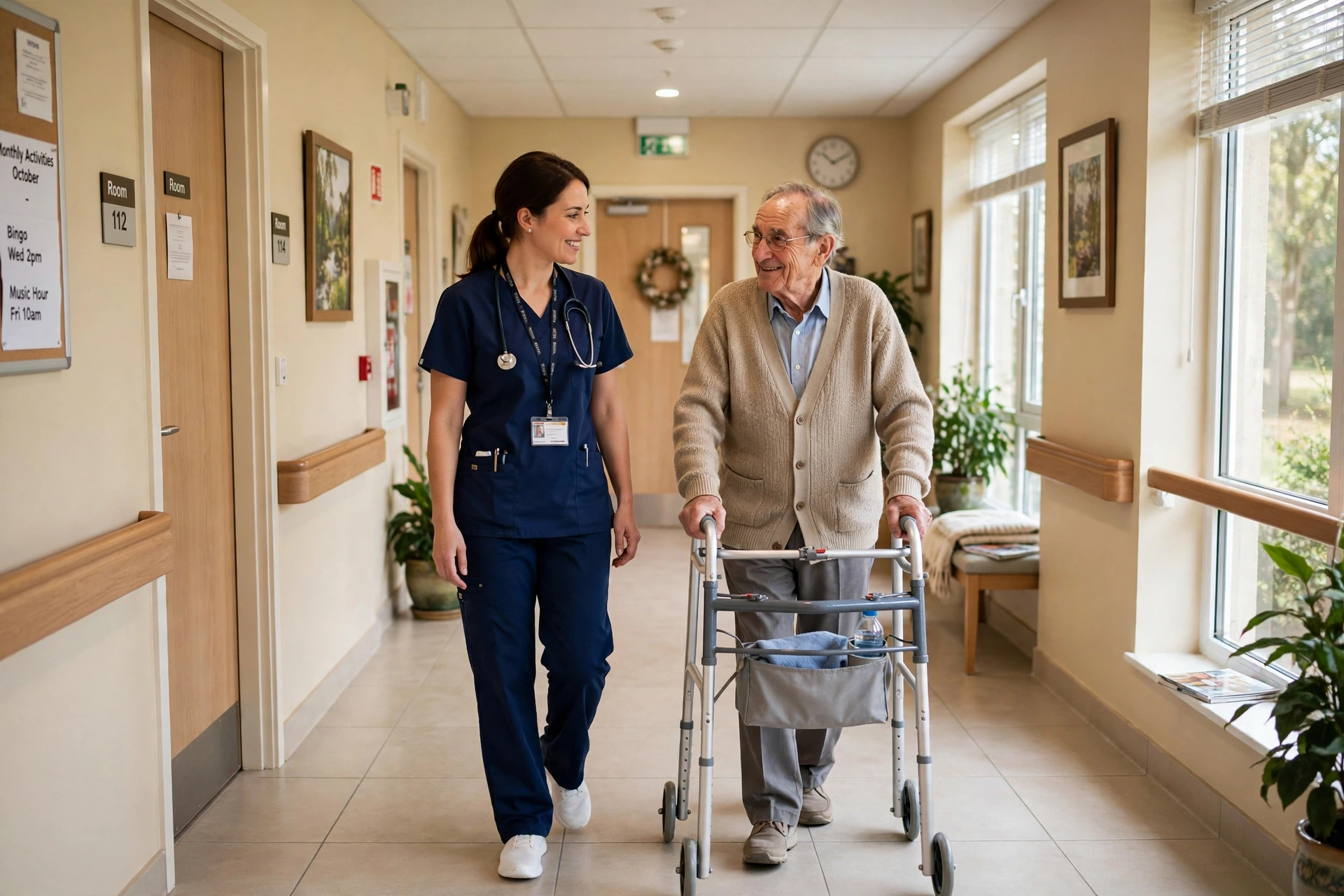
What nursing home jobs hiring near me will you actually find?
Nursing homes hire two kinds of workers. Clinical staff give hands-on care and need state credentials. Support staff keep the building running and usually need nothing more than a diploma and a clean background check.
Nursing assistants are the biggest group by far. The Bureau of Labor Statistics counted 1,558,700 nursing assistant jobs in 2025. About one in three of those jobs sits inside a skilled nursing facility. Demand is structural, not hype: roughly 203,300 openings for nursing assistants are projected each year through 2035, mostly to replace people who retire or change fields.
Role map — clinical and support jobs in a typical nursing home:
| Role | What you do all day | What it takes to qualify | National median pay |
|---|---|---|---|
| Certified Nursing Assistant (CNA) | Help residents bathe, dress, eat, and move; take vital signs; report changes to nurses | State-approved program of 75-150 hours plus a two-part competency exam | $42,260 per year (BLS, May 2025) |
| Licensed Practical Nurse (LPN) | Give medications, dress wounds, supervise CNAs | About 12 months of training plus the NCLEX-PN exam | $64,400 per year (BLS, May 2025) |
| Registered Nurse (RN) | Assess patients, build care plans, supervise LPNs and CNAs | Associate or bachelor’s nursing degree plus the NCLEX-RN exam | $97,550 per year (BLS, May 2025) |
| Dietary aide | Prepare trays, serve meals, clean the kitchen | High school diploma or less | NOT AVAILABLE — BLS does not publish a nursing-home-only figure |
| Housekeeping and laundry | Clean rooms, change linens, restock supplies | High school diploma or less | NOT AVAILABLE — BLS does not publish a nursing-home-only figure |
| Activities assistant | Run games, music sessions, and outings for residents | High school diploma or less | NOT AVAILABLE — BLS does not publish a nursing-home-only figure |
| Receptionist and billing clerk | Answer phones, greet visitors, handle records | High school diploma or less | NOT AVAILABLE — BLS does not publish a nursing-home-only figure |
One line I hear a lot is wrong: you do not always need a license. If your hands touch patients, you need the credential. If your work supports the building, you usually do not. Hands-on care means helping with activities of daily living, known as ADLs: bathing, dressing, eating, and moving.
Do I need a CNA license to work in a nursing home?
You need a CNA license for any hands-on patient care role, such as bathing, feeding, and taking vital signs. The license takes 75 to 150 hours of state-approved training, usually 4 to 12 weeks, plus a written and skills exam. But nursing homes also hire dietary aides, housekeepers, laundry workers, maintenance staff, and receptionists with no license at all. If you want care work without waiting, apply for a support role while you train.
How much do nursing home jobs pay?
Here are the real numbers. Licensed-role pay is the BLS May 2025 national median. The extras are examples printed in recent nursing-home postings, not promises. Every facility sets its own numbers.
Base pay by license (BLS, May 2025):
| License | Median per year | Median per hour |
|---|---|---|
| CNA / nursing assistant | $42,260 | about $20.32 |
| LPN / LVN | $64,400 | about $30.96 |
| RN | $97,550 | about $46.90 |
Pay extras seen in current nursing-home postings:
| Extra | Example from a real posting |
|---|---|
| CNA sign-on bonus | $2,500 for full-time CNAs at a New Jersey care center |
| CNA sign-on bonus | $1,500 plus an evening shift differential at a Minnesota long-term care facility |
| LPN sign-on bonus | $20,000 for full-time LPNs at an Ohio skilled nursing facility |
| RN sign-on bonus | $12,000 for full-time RNs at a Michigan nursing home |
| Shift differential | $0.85 to $2.00 extra per hour for evenings, nights, and weekends |
| Free training | A New York nursing home offers paid CNA training with a full-time job after certification |
Pay is only part of the package. Current postings list health, dental, and vision insurance, 401(k) plans with matching funds, paid time off, and tuition reimbursement. Most nursing homes run three shifts — days, evenings, and nights — with weekend rotations.
Evening, night, and weekend shifts pay the differentials in the table above. Many postings welcome new graduates, so lack of experience rarely blocks you.
Worked example — how a shift differential changes your yearly pay.
Take the national CNA median of $20.32 an hour. A $2.00 evening differential raises it to $22.32 an hour. The math: 40 hours x $22.32 = $892.80 per week. Then $892.80 x 52 weeks = $46,425.60 per year.
Compare that with base pay alone: $20.32 x 2,080 hours = $42,265.60, which matches the BLS median of $42,260. One differential adds about $4,160 a year. When I compared posting after posting, the same pattern kept showing up. The night and weekend shifts nobody wants are the fastest raise you can give yourself.
How much do nursing home CNAs earn?
The national median is $42,260 a year, about $20.32 an hour. That figure comes from Bureau of Labor Statistics May 2025 data. Busy cities and union facilities often pay more than the middle.
Many nursing homes add sign-on bonuses up to $2,500 for CNAs. Shift differentials of $0.85 to $2.00 an hour for evenings, nights, and weekends are also common. Those extras can add several thousand dollars a year.
Which jobs need a license — and which need nothing at all?
The rule is simple. If you provide medical or personal care, the state requires a credential. Nursing assistants must finish a state-approved program and pass a two-part exam: a written or oral test plus a hands-on skills demonstration. Then your name goes on the state CNA registry.
Employers check that registry, so a license from an unapproved school is worthless. I always tell readers to check the state registry directly. That is the habit I follow whenever I verify any certification claim.
LPNs train for about 12 months and pass the NCLEX-PN exam. RNs need a two- or four-year nursing degree and the NCLEX-RN exam. Both exams cost $200 to register, rising to $350 in February 2027 per the NCLEX fee schedule.
No-license roles are the quiet opportunity in this field. Dietary, housekeeping, laundry, maintenance, activities, and front-desk jobs hire with a diploma and a background check. If you want the wider licensed track later, read our guide to LPN jobs near you. For a different no-license desk path in healthcare, see our medical receptionist roles guide.
Do nursing homes pay for CNA training?
Yes, many do. Employer-paid CNA programs are common: the facility covers your tuition and exam fees, and you commit to work there after certification. One New York nursing home advertises paid CNA training with a guaranteed full-time position on completion.
These programs are competitive, so apply early and ask about the work commitment before you sign. State workforce programs sometimes cover tuition too.
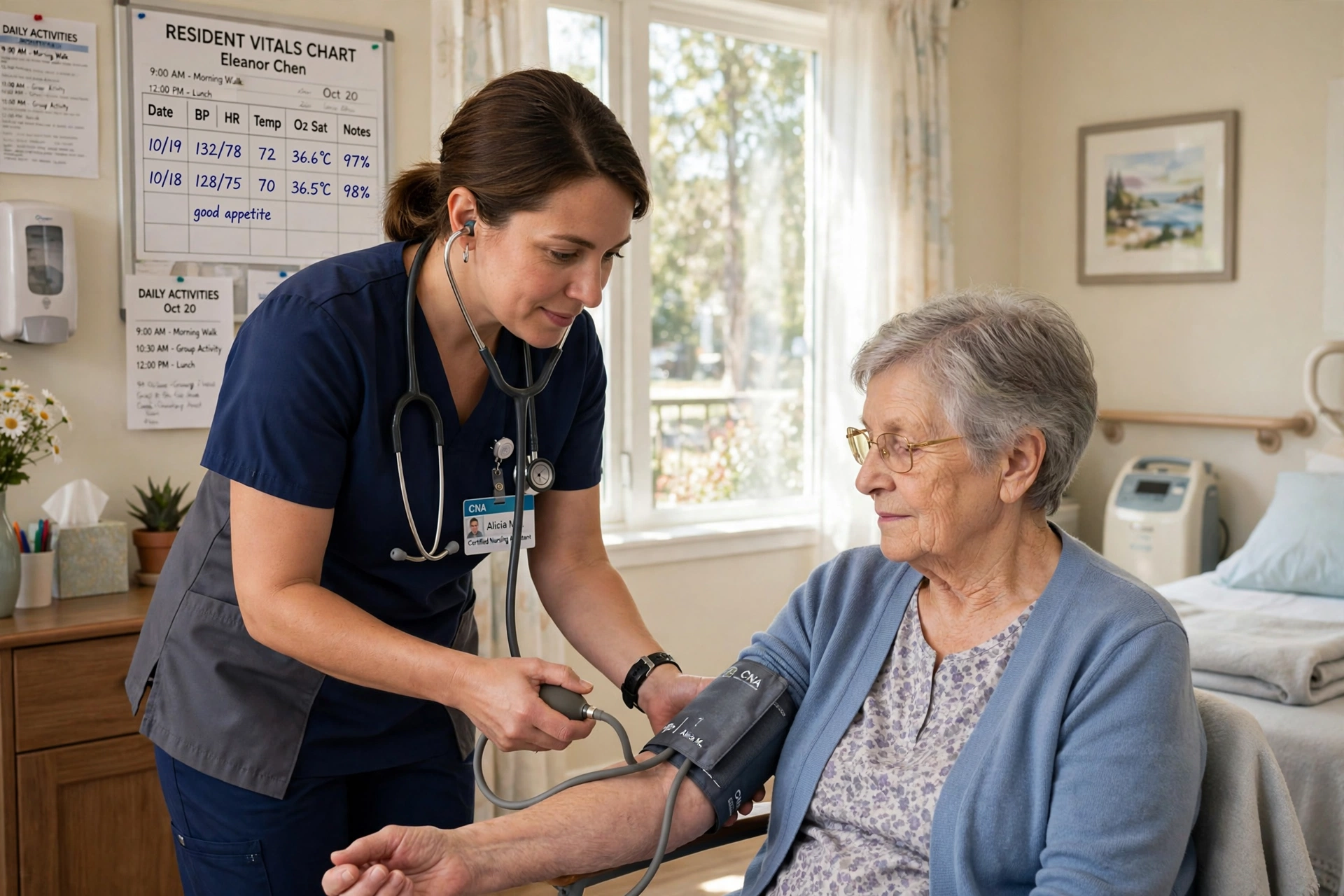
How to apply for nursing home jobs: a step-by-step plan
Here is the exact sequence I recommend, with honest timeframes.
| Step | What to do | How long it takes |
|---|---|---|
| 1 | Decide clinical or support. If you need income this month, target dietary, housekeeping, or reception. | 1 day |
| 2 | If clinical, pick a state-approved CNA program. Confirm it on your state’s nursing board site. | 2-3 days of research |
| 3 | Finish training: 75-150 hours. Accelerated full-time programs run 2-4 weeks; evening programs run 8-16 weeks. | 2-16 weeks |
| 4 | Pass the two-part competency exam and get listed on the state registry. | 1-3 weeks after training |
| 5 | Apply only to postings less than 14 days old that print a pay range. | 1-2 weeks |
| 6 | Interview, background check, TB test, drug screen. Most facilities finish this in under 2 weeks. | 1-2 weeks |
Total: a support role can start within 3 weeks. A CNA path takes 8 to 20 weeks from zero to first paycheck. Facilities that advertise “immediate hire” and paid orientation move fastest.
When a posting lists a named hiring manager and a direct phone number, I treat that as a live job. When it has no date and no pay range, I assume it is stale.
For care settings beyond nursing homes, hospital CNA jobs follow a different pay scale and are worth comparing.
What is the fastest way to get a nursing home job?
The fastest path is a support role. Dietary, housekeeping, or reception can hire within 3 weeks since no license is needed. For clinical work, pick a nursing home that offers paid CNA training with a guaranteed job after certification.
Accelerated programs finish in 2 to 4 weeks. Apply only to postings less than 14 days old that show a pay range and a contact name. Those two filters cut most of the dead listings.
How to find real “hiring near me” postings and skip the stale ones
Job boards rank old listings high because old listings get clicks. You need your own filters.
First, sort by date, not relevance, and ignore anything older than two weeks. Second, prefer the facility’s own careers page over aggregators. A posting on the nursing home’s own site means the job is open right now.
Third, read the listing like a detective. Live postings print a pay range, name the shift, and give a contact person. Dead postings say “competitive pay” and “apply now” with nothing else.
Fourth, call. A two-minute call to the facility’s front desk — “Are you still hiring CNAs for the evening shift?” — beats twenty online applications. In my freelance digital marketing work, I have watched plenty of employers post jobs that never get updated, then hire the person who called.
Fifth, search your state’s workforce or job bank site. These list fewer jobs but almost no stale ones.
One more check I run on any facility: look up its government quality rating on Care Compare. It takes two minutes and tells you how the home is rated for care quality.
Red flags: when a nursing home job post is a scam
Real nursing homes never ask you to pay for the job. Walk away if you see any of these:
- The posting asks for money upfront for training, uniforms, or background checks. Legit facilities provide these free or deduct them from pay with your written consent.
- There is no facility name, address, or license number.
- The “interview” happens only over a chat app with no video call.
- The wage is far above market, like $40 an hour for an uncertified aide.
- They ask for bank details or a photo of your ID before you have an offer letter. A real offer letter comes first, on facility letterhead, with a start date and a pay rate.
The career ladder: from CNA to LPN to RN
This field has one of the clearest pay ladders in healthcare. Look at the BLS medians side by side: CNA $42,260, LPN $64,400, RN $97,550.
Each license is a jump of more than $20,000 a year. The math: $64,400 minus $42,260 = $22,140, and $97,550 minus $64,400 = $33,150.
The steps are realistic. CNA-to-LPN bridge programs often take under 12 months of additional training. LPN-to-RN bridge programs typically run 12 to 18 months full time.
That means a CNA earning $42,260 can reach $64,400 in about a year of part-time study, then $97,550 after another year or two. Few careers offer that kind of mapped-out raise without a four-year degree upfront. When I worked out the figures for this guide, the ladder was the part that surprised me most. The money is not in the first job; it is in the second license.
Are nursing home jobs a good long-term career?
Yes, for people who want a mapped-out path. Start as a CNA at a national median of $42,260 a year. Add an LPN license in about 12 months and the median rises to $64,400.
Finish an RN bridge in 12 to 18 more months and the median reaches $97,550. Demand is steady too: about 203,300 nursing assistant openings are projected each year through 2035. It is physical, shift-based work, but the raises are real and scheduled.
The Short Version
Nursing homes hire clinical staff (CNA, LPN, RN) and support staff (dietary, housekeeping, activities, reception). National median pay: CNA $42,260, LPN $64,400, RN $97,550 per year (BLS, May 2025). Support roles need no license. CNA training takes 4 to 12 weeks and costs $400 to $2,000, though many facilities pay for it.
Sign-on bonuses run up to $2,500 for CNAs and higher for nurses. Apply to postings under 14 days old, prefer facility career pages, and call to confirm. Never pay upfront for a job.
Frequently asked questions
Can I work in a nursing home without a CNA license?
Yes. Dietary aides, housekeepers, laundry workers, maintenance staff, activities assistants, and receptionists need no license, usually just a diploma and a background check. You only need the CNA license for hands-on patient care like bathing, feeding, and taking vital signs. Many people start in a support role for income, then train for the CNA license while employed.
How much do nursing home CNAs make per hour?
The national median is about $20.32 an hour, or $42,260 a year (BLS, May 2025). Pay runs higher in big cities and at union facilities. Evening, night, and weekend shift differentials of $0.85 to $2.00 an hour are common, and sign-on bonuses up to $2,500 appear in current postings. A $2.00 differential on full-time hours adds about $4,160 a year.
Do nursing homes pay for CNA training?
Many do. Employer-paid CNA programs cover tuition and exam fees in exchange for a work commitment after certification. One New York nursing home advertises paid training with a guaranteed full-time position.
These programs are competitive, so apply early and confirm the commitment length in writing before you enroll. State workforce programs can also cover tuition in some areas.
How long does it take to get hired at a nursing home?
A no-license support role can start within 3 weeks: application, interview, background check, and TB test. The CNA path takes 8 to 20 weeks from zero. That breaks down as 2 to 16 weeks of training, 1 to 3 weeks for the exam and registry listing, then 1 to 2 weeks of applying and onboarding. Facilities advertising paid training and immediate hire move fastest.
Are nursing home jobs a good long-term career?
They are if you use the license ladder. CNA work is physical and shift-based, but each license is a $20,000-plus raise: $42,260 to $64,400 to $97,550 at national medians. CNA-to-LPN bridges often take under 12 months, and LPN-to-RN bridges take 12 to 18 months. With about 203,300 nursing assistant openings projected yearly through 2035, steady work is the norm, not the exception.



2 Comments on “Nursing Home Jobs Hiring Near Me: The Complete 2026 Guide”