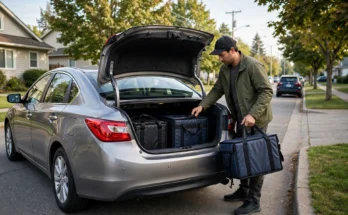
Medical courier jobs pay drivers to move lab specimens, medicines, and medical supplies between clinics, hospitals, and labs. Most roles need a valid license, a clean driving record, and safety training, and couriers earn $16 to $24 an hour in the United States in 2026.
Most job ads for medical courier jobs sound too good to be true, and some are. They promise $45 an hour with no training and no catch. The real job is steadier and less flashy: fixed routes, strict pickup times, and cargo that patients depend on. I research driving and remote job markets for a living, and I have watched this niche grow as labs outsource more of their daily transport. This guide gives you the honest pay ranges, the exact requirements, and a 7-step plan to get hired.
What Medical Couriers Actually Do Each Day
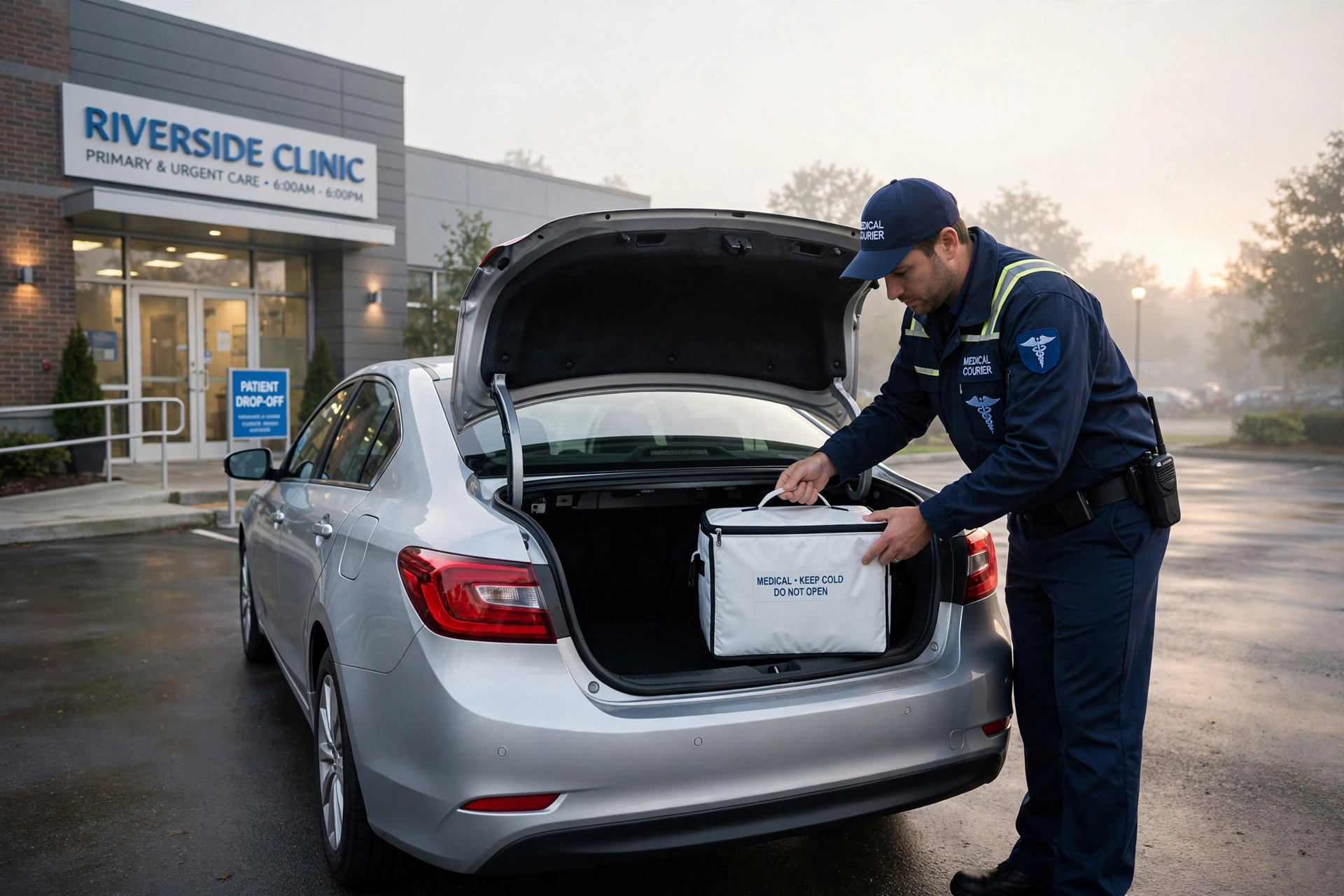
A medical courier picks up, transports, and delivers time-sensitive medical items on a set route. A typical load holds blood samples, urine samples, tissue samples, lab reports, prescriptions, and medical supplies. Each stop has a pickup window, and late delivery can spoil a sample or delay a test result.
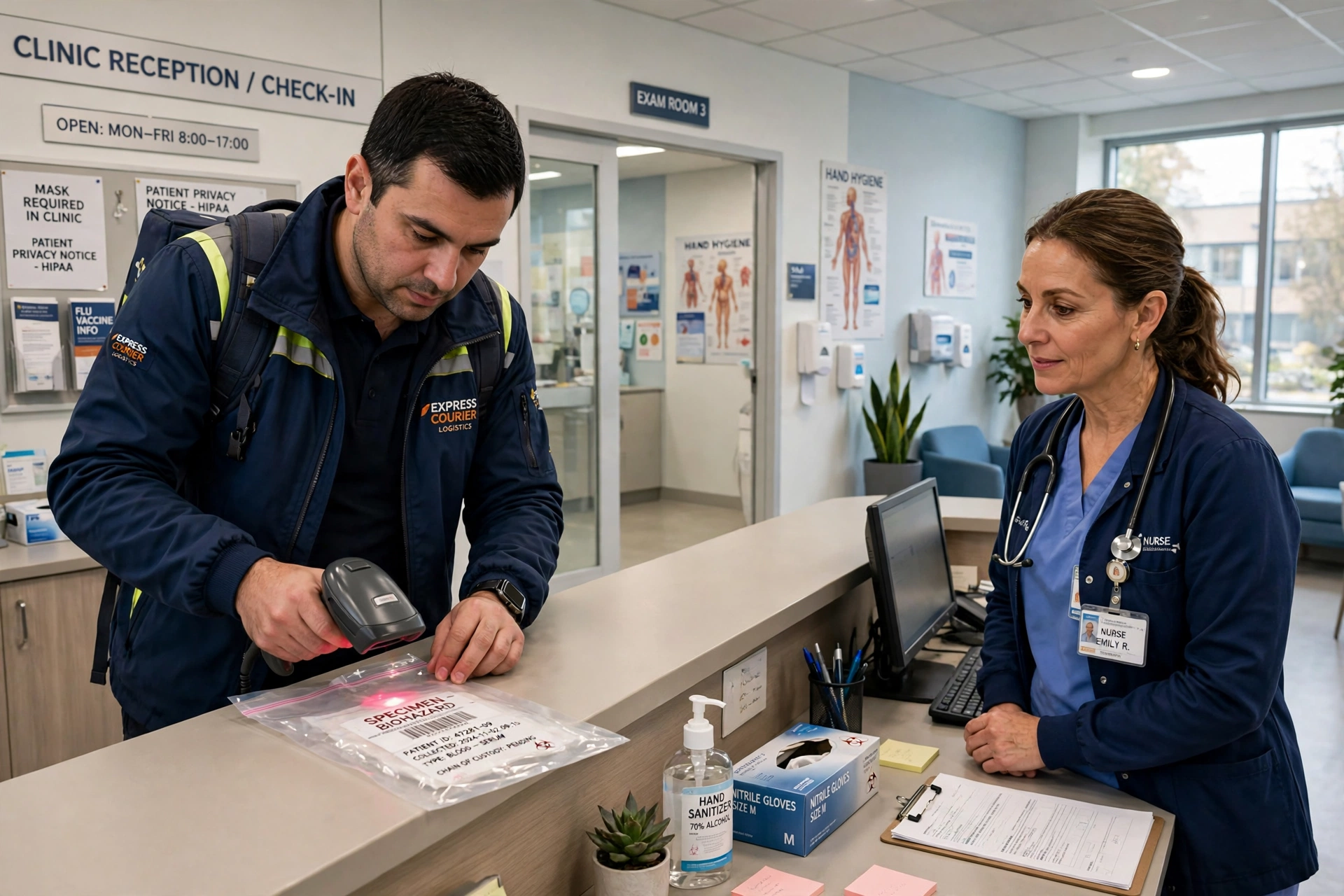
In medical courier jobs, a normal shift starts at a dispatch point or a lab branch. You load the supplies you need for the day, check your route on a handheld scanner or phone app, and drive a loop of clinics, doctor offices, and hospitals. At each stop you scan the bag, check the label against the form, and get a signature. At the end of the shift you return every item to the lab branch and hand over your logs.
Some roles split the day in two. Labcorp runs hybrid courier and specimen-processor roles where the first half of the shift is driving and the second half is sorting and logging samples inside the branch. Other roles are on-demand: you wait for a STAT call, then rush one urgent delivery across town. STAT runs pay more per stop, but the hours are less predictable.
How Much Medical Courier Jobs Pay in 2026
Employee couriers at large lab companies earn less per hour than the ads suggest, but the pay is steady and the vehicle is often supplied. Independent contractors earn more on paper and carry all of their own costs. The table below uses figures from current job posts and 2026 pay guides.
| Role type | Typical pay | What it includes |
|---|---|---|
| Employee courier, hourly | $16 to $24 per hour | Company vehicle or mileage, set schedule |
| Independent contractor, per route | $100 to $250 per day | Gross pay before fuel, insurance, and tax |
| STAT or on-demand runs | $25 to $60 per stop | Urgent single deliveries, irregular hours |
| Specialty transport, hourly | $25 to $40 per hour | Organ, tissue, or high-value medical cargo |
| Overnight and weekend shifts | 10% to 25% extra | Shift premium added to base hourly pay |
Real job posts back up the employee range. Quest Diagnostics listed a Medical Courier – Specialty role in Davenport, Iowa, at $18.50 or more per hour, with a 10% premium for second shift and 15% for third shift. Another Quest post in Irving, Texas, listed $18.35 or more per hour. A Tucker, Georgia, post listed $18 per hour. Pay guides put the full employee range at $36,000 to $46,000 a year, which matches $17 to $22 an hour on a 40-hour week.
For context, the U.S. Bureau of Labor Statistics reports a median wage of $44,860 a year for light truck drivers in May 2025, and $47,700 a year for light truck drivers in the couriers and messengers industry. Medical courier pay sits close to that middle, with specialty roles above it.
Employee or Independent Contractor: The Pay Gap That Matters
This choice shapes your income more than any other decision in medical courier jobs. Employees trade top-end pay for stability. Contractors trade stability for control and higher gross rates. Neither path is right for everyone, and the maths below shows why a big daily rate can still lose.
| Factor | Employee courier | Independent contractor |
|---|---|---|
| Vehicle | Company car or mileage paid | Your own car, your own costs |
| Insurance | Covered by the employer | Commercial policy paid by you |
| Schedule | Fixed route and fixed hours | You pick routes, hours shift often |
| Benefits | Health cover and paid leave common | No benefits, you fund your own |
| Tax | Tax taken from each paycheck | You set aside tax yourself |
| Weekly income risk | Low, pay stays stable | High, slow weeks cut income fast |
Here is a worked example. A contractor runs a route 5 days a week at $180 a day. That is 5 x $180 = $900 gross for the week. Fuel costs $150, the weekly share of commercial insurance costs $60, and maintenance costs $70. That leaves 900 – 150 – 60 – 70 = $620. Setting aside 25% for tax gives 620 x 0.25 = $155, so net pay is 620 – 155 = $465 for the week, or about $11.63 an hour on a 40-hour week.
Now compare an employee on $19 an hour for 40 hours. That is 40 x $19 = $760 gross, with tax already handled and no fuel or car costs. The employee takes home more in this example, even though the contractor headline rate looked bigger. I always tell readers to run this exact maths on any route offer before they sign it, because the gross number alone hides the real story.
Requirements to Get Hired as a Medical Courier
The barrier to entry for medical courier jobs is low, but it is not zero. Most employers ask for the same core items, and missing one of them will stall your application.
- Age 21 or older. Insurance rules push the minimum above the 18 used by many general delivery jobs.
- A valid driver’s license and a clean record. Most employers check the last 3 to 5 years for moving violations and crashes. Quest asks for fewer than 3 moving violations in the last 3 years.
- A background check and a drug screen. Both are standard, since couriers handle patient information and controlled medicines.
- HIPAA training on patient privacy rules. Employers often provide it, and a standalone online course costs about $25.
- OSHA bloodborne pathogens training on safe handling of blood and tissue samples. Employers often provide this too.
- A reliable vehicle and proof of insurance, for contractor roles. Some contracts ask for a newer car, not just any running vehicle. See also delivery jobs with own car if you plan to use your own vehicle.
- A smartphone for dispatch apps, route software, and proof-of-delivery photos.
- Ability to lift up to 30 pounds and stay on your feet for most of the shift.
You do not need a college degree, a nursing qualification, or a commercial driver’s license. A CDL is only needed for large trucks, and medical courier routes use cars and small vans.
How to Get Hired in 7 Steps
- Step 1: Order your driving record. Get your motor vehicle record from your state DMV before you apply anywhere, so a surprise violation does not waste a week of applications.
- Step 2: Finish HIPAA and bloodborne pathogens training. Take the short online courses now if your target employer does not provide them. Each takes under 2 hours, and the certificate strengthens every application.
- Step 3: Check your insurance. Contractors should get a commercial auto quote before accepting a route, since personal policies often exclude paid delivery work. Employees can skip this step.
- Step 4: Apply to the big lab employers first. Labcorp and Quest Diagnostics run the largest courier fleets in the United States, and they post roles in most states. MedSpeed and regional firms like Medical Delivery Services are strong second choices.
- Step 5: Apply to 10 roles in one week. Treat it like a route: a batch of applications each morning, then follow up after 5 days. One application at a time is the slowest way to get hired.
- Step 6: Prepare for the road test and interview. Employers check how you handle a vehicle, read a route sheet, and talk to clinic staff. Practice a calm, professional greeting, since you represent the lab at every stop.
- Step 7: Accept the route that fits your maths. Use the worked example above on each offer. A route that pays $200 a day but covers 200 miles may pay less per hour than a $150 route covering 60 miles.
Companies That Hire Medical Couriers
Labcorp and Quest Diagnostics are the two largest employers in medical courier jobs, with courier posts in dozens of cities and company vehicles on most routes. MedSpeed focuses on healthcare logistics and hires both employees and contractors. Smaller regional firms, hospital transport teams, and pharmacy delivery services also hire, and they often post on Indeed and ZipRecruiter rather than their own sites. For nearby driving work, see local truck driver jobs near me, and for another large delivery employer, see Amazon delivery driver jobs.
I have noticed that the best openings rarely sit on one job board for long. Set alerts for the exact phrase “medical courier jobs” on two boards, and check Labcorp and Quest career pages once a week. A role posted on Monday can close by Friday when a route needs urgent cover.
5 Mistakes That Cost New Couriers Money
First, trusting the $45-an-hour headline. That figure is the contractor ceiling after costs, not the starting wage. Second, skipping commercial insurance. One crash on a personal policy can end a contract and leave you with the bill. Third, ignoring mileage. A long route at a flat daily rate can pay less per hour than a short one. Fourth, rushing specimen labels. One mislabeled bag can void a test and cost you the route. Fifth, quitting in week one. Routes get faster as you learn the stops, and the first 2 weeks are always the slowest.
The Short Version
Medical courier jobs are a solid fit if you like driving, want steady work, and can handle strict schedules. Expect $16 to $24 an hour as an employee, or $100 to $250 a day gross as a contractor before costs. You need a license, a clean record, a background check, and short safety training. No degree and no CDL are needed. Apply to Labcorp and Quest first, run the maths on every offer, and pick the route that pays best per hour, not per day.
How I worked out the figures in this article: I compared current Quest Diagnostics job posts with 2026 pay guides and the Bureau of Labor Statistics median wage for light truck drivers, then ran the contractor maths above from those published rates. Where a figure was not published, I left it out rather than guessing.
Frequently Asked Questions
What does a medical courier do?
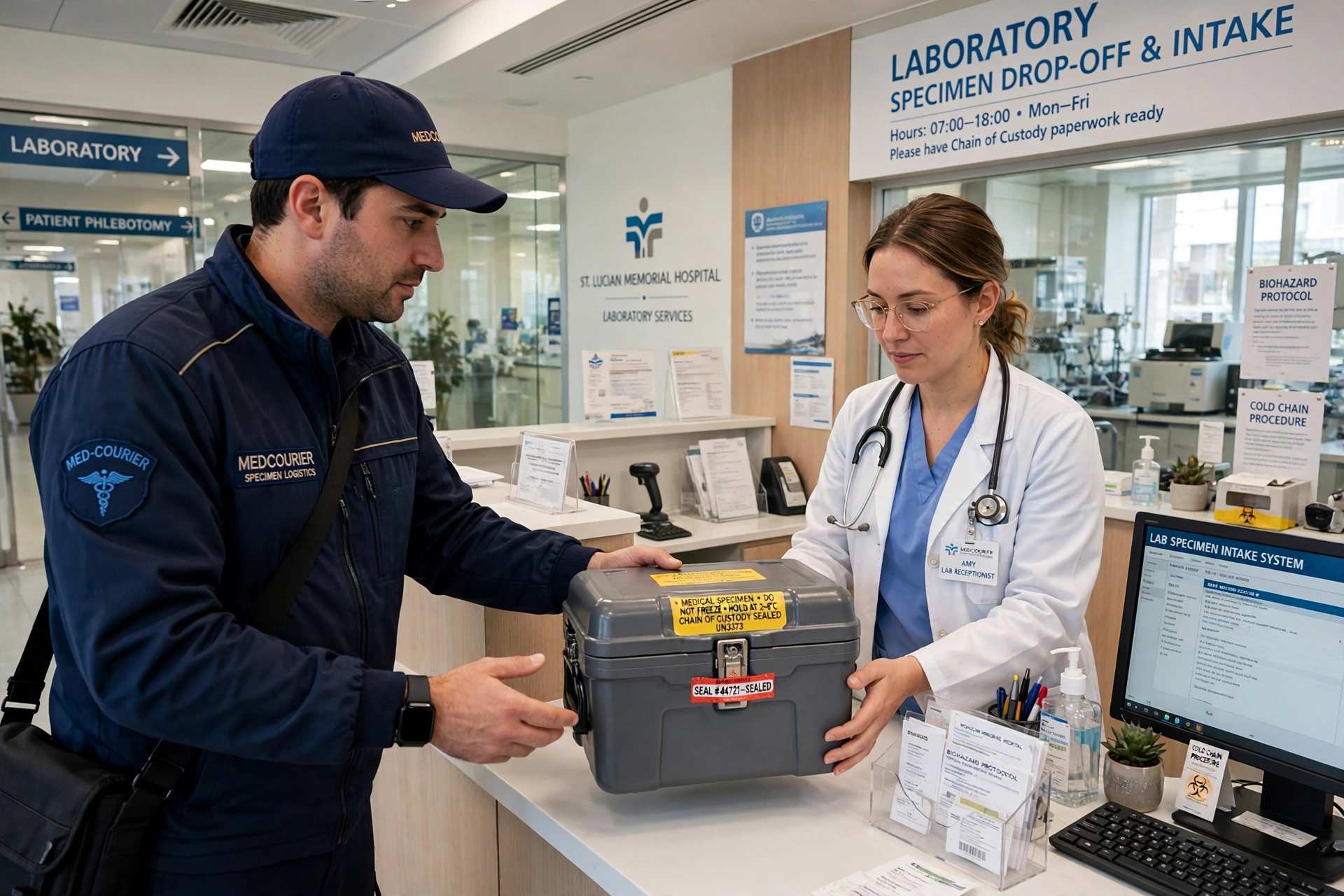
A medical courier picks up, transports, and delivers lab specimens, medicines, and medical supplies between clinics, hospitals, and labs. Each day follows a set route with fixed pickup times, and every bag is scanned, labeled, and signed for at each stop. Couriers also keep temperature control and chain-of-custody records for sensitive cargo. They check temperature logs at pickup and report any damaged or late bag to dispatch right away.
Do medical courier jobs need a degree or a CDL?
No. Medical courier jobs need no college degree and no commercial driver’s license. Employers ask for a valid license, a clean driving record, a background check, and short HIPAA and bloodborne pathogens training. Routes use cars and small vans, so a CDL is only needed for large trucks. Training is short and often free, since employers run it during onboarding for new hires.
How much do medical courier jobs pay per hour?
Employee medical couriers typically earn $16 to $24 an hour, or about $36,000 to $46,000 a year. Independent contractors earn $100 to $250 a day gross, but they pay their own fuel, insurance, and maintenance. Specialty transport and overnight shifts pay more, with premiums of 10% to 25%. Shift premiums lift night and weekend pay, and specialty roles can reach $25 to $40 an hour.
How long does it take to become a medical courier?
Most people can get hired in 2 to 4 weeks if they move fast. Ordering your driving record takes a few days, HIPAA and bloodborne training takes under 2 hours each, and background checks take 1 to 2 weeks. Applying to 10 roles in one week, rather than one at a time, keeps the process short. A clean driving record speeds things up, while a violation on your record can add weeks.
Is medical courier work a good side job?
It can be, but only as a contractor on flexible routes. Employee roles need fixed shifts, which rarely fit around another job. Contractors can pick on-demand STAT runs, yet income shifts week to week, and vehicle costs eat into the headline rate. Run the weekly maths before you treat it as steady side income.
About the Author
Mohsin Rabnawaz is the author of Skimzo. With a background in Artificial Intelligence and years of experience as a freelance digital marketer, he researches job markets and writes guides that help readers find real work with honest pay figures.