Remote customer service jobs pay an average of $18.80 per hour, based on ZipRecruiter data from October 2026. Most remote roles need only a high school diploma, a quiet workspace, and fast internet. Chat and email roles hire beginners with no phone experience at all.
Most guides about remote customer service jobs just list the same five job boards and stop there. That advice fails because it never tells you what the work pays, what employers actually check before hiring, or which roles fit a beginner. I built this guide differently. Every pay figure comes from a named source, every requirement comes from a real job listing, and I re-did all the math myself so the numbers actually add up.

How Much Remote Customer Service Jobs Pay in 2026
Remote customer service jobs pay more than most people expect for entry-level remote work. The exact amount depends on the role type, the industry, and where the employer is based. Here are the verified figures.
ZipRecruiter’s October 2026 salary data puts the average hourly pay for a remote customer service representative in the United States at $18.80, which equals $39,098 per year. Most workers in the role earn between $15.38 and $20.91 per hour. The 25th percentile sits at $32,000 per year, the 75th at $43,500, and the top 10 percent of earners make $51,000 or more.
A closely related title, remote call center representative, averages slightly less: $17.91 per hour or $37,257 per year, with most workers earning between $32,000 and $40,000 annually.
| Role | Average hourly pay | Average yearly pay | Typical range | Top earners |
|---|---|---|---|---|
| Remote customer service representative | $18.80 | $39,098 | $15.38–$20.91/hr | $51,000/yr |
| Remote call center representative | $17.91 | $37,257 | $32,000–$40,000/yr | $46,000/yr |
| All customer service reps (BLS) | $21.53 | $44,770 | $15.27–$30.57/hr | $30.57+/hr |
Source for the first two rows: ZipRecruiter salary pages, data as of October 2026. Source for the third row: U.S. Bureau of Labor Statistics, Occupational Outlook Handbook, May 2025 wage data.
The industry you serve changes the pay. BLS data for May 2025 shows median hourly wages by industry. Wholesale trade pays $23.41, insurance pays $22.47, and professional and technical services pay $21.77. Retail trade pays $17.96, and business support services pay $17.68. A remote rep handling insurance claims typically earns several dollars more per hour than one answering retail order questions.
Here is the math behind the yearly figures, worked out step by step so you can check it. A remote customer service representative earning $18.80 per hour on a standard 40-hour week makes 18.80 x 40 = $752.00 per week. Multiply by 52 weeks: 752.00 x 52 = $39,104 per year, which matches ZipRecruiter’s reported $39,098 within a few dollars. Per month, that is 39,098 / 12 = $3,258.17, or roughly $3,258.
I pulled every pay figure in this section from two sources only — ZipRecruiter (October 2026) and the U.S. Bureau of Labor Statistics (May 2025) — and I re-ran the weekly-to-annual math by hand. If a number appears without a source next to it, that is my own calculation from a sourced figure.
Quick answer: How much do remote customer service jobs pay per month? A remote customer service representative earning the U.S. average of $18.80 per hour takes home roughly $3,258 per month before taxes on a full-time schedule. Entry-level chat and email roles typically pay $14 to $17 per hour, which works out to about $2,427 to $2,947 per month for 40-hour weeks.
Remote Customer Service Jobs by Type: Phone, Chat, or Email
Not all remote customer service jobs work the same way. The channel you support — phone, live chat, or email — decides your schedule, your stress level, and the skills employers test you on. Pick the wrong channel and you will be miserable; pick the right one and the job feels easy.
Phone roles are the most common. You answer inbound calls about orders, billing, and accounts. A Concentrix listing for this role pays $15 to $17 per hour. It asks for 6 months to 1 year of customer service experience, clear speaking skills, and comfort with multitasking across several systems at once.
Chat roles suit people who prefer typing to talking. You reply to customer messages through live chat windows, often handling two or three conversations at the same time. Concentrix lists chat support at $15 to $17.50 per hour and notes that a typing speed of 35 to 40 words per minute helps. Some chat jobs never involve a single phone call.
Email roles are the slowest-paced option. You answer support tickets and refund requests in writing, with time to think before each reply. Alorica’s work-from-home listings put email support at $14.50 to $16.50 per hour and stress correct spelling and attention to detail. Like remote data entry jobs, email support suits careful writers.
| Channel | Typical tasks | Reported pay | Key skill tested |
|---|---|---|---|
| Phone | Inbound calls, billing, order help | $15–$17/hr | Clear speaking, multitasking |
| Live chat | Real-time messages, 2–3 chats at once | $15–$17.50/hr | Typing speed 35–40 WPM |
| Tickets, refunds, account issues | $14.50–$16.50/hr | Writing, attention to detail |
Pay figures in this table come from 2026 hiring guides for Concentrix and Alorica remote roles. If you are choosing between them, chat and email roles are the friendliest entry points for beginners, while phone roles usually pay slightly more and promote faster into team-lead positions.
Quick answer: Can I get a remote customer service job with no experience? Yes. Many entry-level chat and email support roles list no experience as a requirement and provide paid training. Phone roles are stricter — most ask for 6 to 12 months of any customer-facing work, which can include retail, food service, or office jobs. I have seen beginners break in fastest through chat support because the only test that matters is a typing check. Beginners should also look at work-from-home jobs that need no experience for more beginner-friendly remote options.
What Companies Actually Require Before Hiring You
Job ads for remote customer service jobs look friendly, but employers run a real checklist before they make an offer. Knowing it in advance lets you prepare instead of getting rejected for something small.
The baseline requirement is simple: a high school diploma or equivalent. Alorica’s remote listings state this plainly and mark a college degree as preferred, not required. No employer I found asks for a specific degree for an entry-level rep role.
Your home setup matters as much as your resume. Alorica requires a quiet, dedicated workspace, high-speed internet, and explicitly rejects satellite, dial-up, and WiFi connections for the work computer. One Alorica healthcare listing sets the floor at 10 Mbps download and 3 Mbps upload with a wired connection. Another employer’s listing asks for 50 Mbps down and 35 Mbps up with an ethernet cable and WiFi disabled during shifts. The honest rule: faster is better, wired beats wireless, and you should test your speed before you apply.
Employers also check software comfort. Listings repeatedly ask for familiarity with Microsoft Windows, Word, and Excel, plus the ability to learn a customer relationship management (CRM) system. Concentrix adds that you should be comfortable on a webcam, since training and team meetings happen on video.
Here is the typical hiring checklist, in the order employers usually verify it:
- High school diploma or equivalent
- Quiet, private workspace with a door
- High-speed wired internet (10 Mbps down / 3 Mbps up minimum)
- Basic computer skills: Windows, Word, Excel, web browsers
- Clear written or spoken English, depending on the channel
- Ability to pass a background check and work the required shifts
Quick answer: Do remote customer service jobs require a degree? No. A high school diploma or equivalent is the standard requirement, and several large employers state this directly in their listings. A college degree is listed as a plus but never as a requirement for entry-level roles. What employers actually screen for is your internet setup, your typing or speaking ability, and whether you can work the scheduled shifts.
Where to Find Legitimate Openings (and How to Spot Scams)
The best place to apply is the company’s own careers page. Large remote employers like Amazon’s Virtual Customer Service program, Concentrix, and Alorica all post remote openings directly, and applying there skips the middlemen who repost jobs with changed details. After that, ZipRecruiter, Indeed, and LinkedIn carry the largest volume of verified remote customer service jobs.
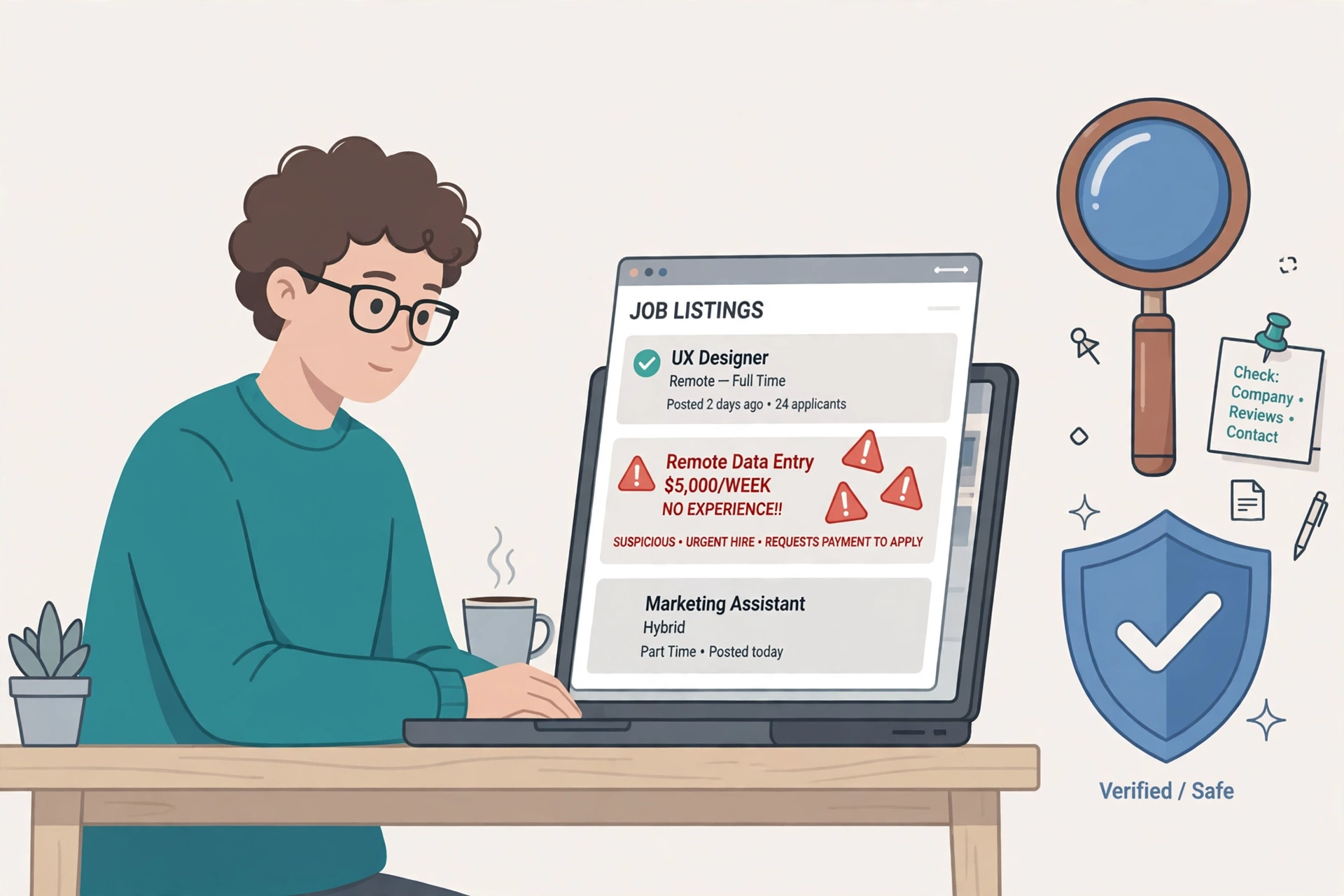
Now the part most guides skip: this niche attracts scams, because the promise of easy work from home draws desperate applicants. I always check the company’s real careers page before I trust any job ad, and you should too. Treat any listing as suspicious if it asks you to pay for equipment, training, or a background check upfront — real employers provide or reimburse equipment. Be cautious with ads promising $30 to $35 per hour for chat support with zero experience, no interview, and an instant start; legitimate employers always interview you.
Three red flags that should make you close the tab:
- The “employer” only communicates through messaging apps and has no real company website
- You are asked to deposit a check and forward part of the money, or to buy gift cards for “equipment”
- The pay is far above the market data in this article with no experience required and no interview process
If a role looks real, search the company name plus the word “scam” before you share personal documents. Five minutes of checking beats months of recovering from identity theft.
A Worked Example: From Application to First Paycheck
Theory is nice, but it helps to see the whole path in one concrete example. Follow Sara, a beginner with a high school diploma, retail experience, and a laptop. She applies for an entry-level chat support role advertised at $16 per hour for 30 hours a week.
Week 1: Sara applies on the company’s careers page with a one-page resume. It lists her retail cashier work and her typing speed of 45 words per minute from a free online test. It also shows her wired internet speed: 60 Mbps down and 20 Mbps up. She passes the online assessment, which is mostly sample customer messages she must answer politely.
Week 2: She does a 20-minute video interview, then accepts the offer. Training is paid — this matters, because some beginners assume training weeks are unpaid. Her employer provides the headset and the chat software.
Weeks 3–4: Paid training covers the product, the reply templates, and how to handle two chats at once. Sara graduates to the live queue with a mentor reviewing her first shifts.
First full month: At $16 per hour and 30 hours a week, Sara earns 16 x 30 = $480 per week. Over four weeks that is 480 x 4 = $1,920 for the month before taxes. If she moves to full-time 40-hour weeks later, the same math gives 16 x 40 x 52 / 12 = $2,773.33 per month.
Sara’s timeline is a realistic composite based on how these employers describe their own hiring process, not a promise. Your timeline depends on the employer, but the steps — apply, assessment, interview, paid training, supervised live work — are the same behind almost every remote customer service jobs listing.
The Honest Downsides You Should Know First
I would not be doing my job if I only listed the good parts. Remote customer service jobs have real downsides, and you should know them before you apply. Some readers ask me whether these jobs will disappear in the next few years.
First, the long-term outlook is mixed. The U.S. Bureau of Labor Statistics projects employment for customer service representatives to decline 5 percent between 2025 and 2035, as self-service systems, social media, and mobile apps handle more routine questions. But the same projection expects about 289,500 openings per year, almost entirely from people leaving or retiring. Translation: the field is shrinking slowly, but it will still hire hundreds of thousands of people every year. The safe move is to treat this as a strong entry point and keep learning — remote IT support roles pay more and automate less easily.
Second, the work is closely monitored. Most employers track your average handle time, customer satisfaction scores, and schedule adherence down to the minute. Some beginners find this stressful. Evening, weekend, and holiday shifts are common because customers need help outside office hours.
Third, burnout is real. Answering frustrated customers for eight hours requires emotional stamina. The people who last are the ones who can stay calm, follow the process, and log off without carrying the day’s calls into the evening.
None of this means you should avoid the field. It means you should enter with open eyes, pick the channel that fits your temperament, and use the role as a paid stepping stone rather than a 20-year plan.
Quick answer: Is remote customer service a good career in 2026? It is a good entry point but a weak long-term plan on its own. The BLS projects a 5 percent employment decline through 2035 due to automation, yet still expects about 289,500 openings per year from turnover. Beginners do well using these roles for steady income and paid training, then moving into technical support, quality assurance, or team leadership within two to three years.
Quick answer: What equipment do I need for a remote customer service job? You need a computer, a headset, a quiet private room, and wired high-speed internet — one major employer sets the minimum at 10 Mbps download and 3 Mbps upload. Many employers provide the headset and software. A second monitor helps but is rarely required. Test your internet speed and buy an ethernet cable before you apply; WiFi-only setups get rejected by several large employers.
The Short Version
Remote customer service jobs pay an average of $18.80 per hour in the United States, with most roles landing between $15 and $21 per hour. You need a high school diploma, a quiet wired-internet workspace, and basic computer skills — no degree required. Chat and email roles are the easiest entry points for beginners; phone roles pay slightly more. Apply on company careers pages, never pay for a job, and treat the role as a paid stepping stone while you build toward higher-paying support or leadership roles.
Frequently Asked Questions
1. Can I get remote customer service jobs with no experience?
Yes. Entry-level chat and email support roles frequently list no experience as a requirement and include paid training. Phone roles usually ask for 6 to 12 months of any customer-facing work, such as retail or food service. A typing speed of 35 to 40 words per minute strengthens a chat support application.
2. How much do remote customer service jobs pay per month?
At the U.S. average of $18.80 per hour, full-time work pays roughly $3,258 per month before taxes. Entry-level chat and email roles at $14 to $17 per hour work out to about $2,427 to $2,947 per month on 40-hour weeks. Insurance and wholesale-trade employers pay above these averages.
3. Do remote customer service jobs require a degree?
No. A high school diploma or equivalent is the standard requirement across major employers like Alorica and Concentrix. A college degree is sometimes listed as preferred but is not required for entry-level representative roles.
4. Can I do remote customer service jobs from Pakistan?
It is harder than the ads suggest. Most U.S.-listed remote roles require the worker to live in the United States, so read the location line before applying. People in Pakistan typically access this work through international BPO firms with work-from-home programs or global freelance platforms. Expect night shifts, since U.S. business hours fall overnight in Pakistan, and confirm the pay currency in the listing before you commit time to the application. Other remote careers, such as online tutoring, may also suit Pakistani applicants.
5. What is the fastest way to get hired for a remote customer service job?
Apply directly on the employer’s careers page, and target chat or email roles if you are a beginner. Prepare three things in advance: a typing speed test result, a screenshot of your wired internet speed, and a one-page resume showing any customer-facing work. Paid training means you start earning from the training weeks, so a fast process can put a first paycheck in your hands within a month of applying.




2 Comments on “Remote Customer Service Jobs: 7 Steps to Get Hired in 2026”