
Getting your first job on Upwork from Pakistan means setting up a fully verified profile, learning how connects work, targeting smaller fixed-price jobs with few proposals, and writing a proposal that proves you read the job post. Most beginners land their first client within two to six weeks.
Most Upwork advice online is written for freelancers in the US or UK, where connects are cheap relative to income and clients don’t judge you for your country. That advice doesn’t hold up here. I have a background in artificial intelligence and years of experience as a freelance digital marketer, and I built SKIMZO because I kept running into the same gap: guides that ignore what actually changes when you’re bidding in dollars but budgeting in rupees. I checked every figure in this article myself before publishing it, rather than repeating whatever number showed up first in a search. This is written from that angle, with real numbers, not vague reassurance.
Set Up Your Profile the Right Way for Pakistan
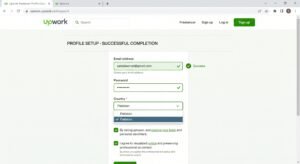
Your Upwork profile is the first thing a client checks before reading your proposal. An incomplete profile doesn’t just look weak to a client, Upwork’s own matching system filters it out before a client ever sees it, so this step gates everything that follows.
Sign up as an “Individual” freelancer and select Pakistan as your country. Use your real name exactly as it appears on your CNIC or passport, because Upwork verifies identity for freelancers here, and a mismatch causes account problems later. Keep a clear photo of your CNIC or passport ready, since Upwork often asks for it within the first few days. This is routine, not a red flag.
Complete every section of your profile before applying to a single job. An incomplete profile is filtered out by Upwork’s own matching system, so half-finished profiles rarely get seen at all.
Understand How Connects Work Before You Spend Them
Connects are the currency you spend to apply for jobs on Upwork. New accounts get 10 free connects a month, and after that you buy them.
Each connect costs $0.15. A typical job application costs 4 to 6 connects for smaller jobs and 10 to 16 connects for more competitive ones. If you subscribe to Freelancer Plus at roughly $20 a month, you get 100 connects included, which works out cheaper per connect than buying small bundles.
Here’s the math a lot of guides skip. If you apply to 15 jobs a month at an average of 6 connects each, that’s 90 connects, or $13.50 in connects alone (90 × $0.15 = $13.50). Budget for that before you count your first month’s income, because it’s a real cost even before you win anything.
Don’t spend connects on jobs with 50 or more proposals already submitted, jobs posted more than a few days ago, or vague one-line job descriptions. Save them for fresh postings that match your skill exactly.
Understand Upwork’s Fees Before You Price Your Work
Once a client accepts your proposal and the contract starts, here’s what actually happens to your money. I checked this directly against Upwork’s own Freelancer Service Fee page rather than relying on third-party blogs, since fee numbers online varied enough that I didn’t trust a secondhand figure. Upwork charges a variable freelancer service fee of 0% to 15% per contract, and most freelancers land around 10%. The exact rate is shown to you the moment you submit a proposal or receive an offer, and it locks in for the life of that contract, so you always know your number before you accept any work.
Here’s the math using that typical 10% rate on a $500 fixed-price project: $500 minus ($500 × 0.10) equals $450 landing in your Upwork account before Payoneer’s transfer fee. Always price your work with the fee already subtracted in your head, not as a surprise at withdrawal.
Find Beginner-Friendly Jobs Worth Applying To
Not every job on Upwork is worth your connects. Because each application costs real money, applying to overcrowded jobs isn’t just a low-odds bet, it’s a direct loss on your connects budget every time it doesn’t convert. As a beginner, you’re looking for smaller jobs with less competition, not high-profile contracts that attract fifty applicants in an hour.
Use the filters. Set your minimum budget so you skip jobs attracting desperate, unrealistic clients. Filter for “fewer than 5 proposals” so you’re not buried under experienced freelancers. Filter client history for clients who have hired before, since they already understand how to work with freelancers and are less likely to disappear mid-project.
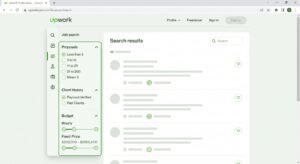
Fixed-price jobs between $100 and $500 tend to be the easiest entry point. Hourly contracts require the client to trust you with unsupervised time before you’ve proven anything, which is a harder sell with zero reviews. Fixed-price work is lower risk for the client, faster to complete, and gets you your first review sooner.
On a fixed-price contract, larger jobs are usually split into milestones, separate payments released as you complete agreed chunks of work rather than one lump sum at the end. As a beginner, this protects you too: instead of waiting weeks for a single payout, you get paid as each piece is approved, and a client who disappears mid-project still owes you for the milestones already delivered.
Write a Proposal That Actually Gets Read
Clients scanning thirty proposals don’t read essays. They skim for one thing: does this person understand my actual problem.
Open with something specific from the job post, not a greeting. “Hi, I am a professional freelancer with three years of experience” gets skipped instantly, because clients have read that exact line hundreds of times. Instead, reference a detail from their description in your first sentence, so it’s obvious you actually read it.
Keep the whole proposal under 200 words. State what you understood the problem to be, briefly explain how you’d approach it, and end with one clear next step, like offering to share a sample or asking a specific question about their timeline. Long, generic proposals lose to short, specific ones almost every time.
What to Show With Zero Portfolio or Experience
Most beginners assume they need finished client work before they can apply anywhere, but that’s not true. If you have no professional samples yet, create some: a mock website redesign, a sample article in your niche, a practice data-entry sheet, or a small project done for a friend or local business. Something is always better than nothing on your profile.
For your very first paid job specifically, consider a small, clearly-scoped engagement at a lower price than you’ll eventually charge, and say so plainly in your proposal. Framing it as “I’m building my Upwork track record, so I’m pricing this lower for the right first project” is honest and gives the client a reason to take a chance on you.
How to Spot a Scam Job Posting
A small number of postings on Upwork aren’t real jobs. Watch for a few repeating patterns: a client asking you to communicate or pay outside Upwork before a contract even starts, a job offering payment that’s clearly too high for how little work is described, or a request to buy equipment or software upfront and get “reimbursed” later. Genuine clients pay through Upwork’s own system and don’t ask you to move money before work begins. If something feels off, trust that instinct and move on to the next job rather than risking your time or your connects.
Job Success Score: What Happens After Job One
Once you complete your first contract, Upwork starts tracking your Job Success Score (JSS), a number based on client feedback, repeat work, and how contracts end. This score is what determines whether future clients trust you at a glance, so treat your first review as the start of something, not the finish line. New freelancers with a strong, complete profile and good early reviews can also qualify for Upwork’s Rising Talent badge, which boosts visibility in client searches for a limited window. It won’t make or break your first job, but it’s worth knowing it exists so you don’t waste the momentum a good first review gives you.
Get Paid in Pakistan: Payoneer to Bank
Upwork pays Pakistani freelancers through Payoneer, not direct bank deposit. You link a Payoneer account to your Upwork profile to receive funds.
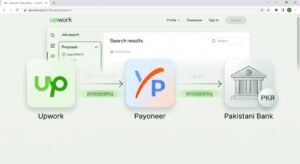
Fixed-price contracts typically release payment about 5 business days after the client approves your delivery. From Payoneer, you then transfer to a local Pakistani bank account, a process that usually takes 2 to 3 business days. Payoneer charges a transfer fee of roughly 2% on that step, which is standard for this kind of international transfer.
| Step | What Happens | Typical Timeline |
|---|---|---|
| Client approves delivery | Upwork releases the funds | Same day as approval |
| Funds clear on Upwork | Money moves to your Payoneer balance | Up to 5 business days |
| Payoneer to bank transfer | You withdraw to a Pakistani bank | 2–3 business days |
| Bank credits your account | HBL, Meezan, UBL, MCB, Bank Alfalah all supported | Same day as transfer completion |
Common Mistakes That Keep Beginners Stuck
Most beginners trying to land their first Upwork job don’t fail because they lack skill. They fail because of a handful of repeated, avoidable mistakes.
Applying to every job you see, instead of filtering carefully, wastes connects fast and rarely improves your odds. Sending the same generic proposal to fifty different jobs is easy to spot from the client’s side, and it kills your response rate. Underpricing dramatically to seem competitive backfires too, since extremely low rates read as low quality rather than good value to most clients.
Giving up in the first two weeks is the most common mistake of all. The first month on Upwork is genuinely the hardest part for almost everyone, and most people who quit do it right before momentum would have started building.
| Connects Spent | Cost in USD | Realistic Use |
|---|---|---|
| 10 (free monthly) | $0.00 | 1–2 low-competition job applications |
| 60 (a typical month) | $9.00 | 10 targeted proposals at ~6 connects each |
| 100 (Freelancer Plus) | $20.00/month flat | 15–25 proposals depending on job type |
How I Checked These Numbers
I want to be upfront about how I put this together, because a lot of freelancing content online just repeats whatever number ranks first. For the fee figures in this article, I went to Upwork’s own support documentation directly rather than trusting third-party blog posts, several of which currently disagree with each other. For the Payoneer transfer details, I cross-checked against beginner guides written specifically from a Pakistani freelancer’s perspective, since global guides usually skip that step entirely. Where I couldn’t confirm a number with a source I trusted, I left it out rather than guess. I’d rather give you five solid numbers than fifteen shaky ones.
If a number in this article changes, it will most likely be the exact percentage Upwork puts on your contract. That’s expected, since Upwork sets it individually based on factors it doesn’t fully publish. What won’t change is the process: check your rate before accepting, and price accordingly.
The Short Version
Complete your Upwork profile fully and verify your identity with your CNIC before applying to anything. Budget your connects like real money, because at $0.15 each they add up fast. Target smaller fixed-price jobs with fewer than five proposals instead of chasing high-competition listings. Write short, specific proposals that reference the actual job post. Expect payment through Payoneer, with a short delay before it reaches your Pakistani bank account. Most freelancers who stay consistent land their first client within two to six weeks.
Frequently Asked Questions
How long does it take to get your first job on Upwork from Pakistan?
Most consistent beginners land their first contract within two to six weeks. The main factor isn’t skill level, it’s whether you’re applying to fresh, low-competition jobs with a tailored proposal rather than mass-applying with a generic one. Freelancers who send a handful of specific, well-researched proposals every day tend to move faster than those who send many generic ones, because clients notice the difference immediately when scanning applicants.
How much does Upwork charge in fees?
Upwork charges a variable freelancer service fee between 0% and 15% per contract, with most freelancers landing around 10%. Your exact rate is shown when you submit a proposal or receive an offer, and it stays fixed once the contract starts. On a $500 project at a 10% fee, you’d take home $450 before any Payoneer transfer costs, so always price your rate with that fee already factored in.
How do I get paid on Upwork in Pakistan?
You link a Payoneer account to your Upwork profile to receive earnings, since direct bank deposit isn’t offered here. Fixed-price payments usually release about 5 business days after client approval, and hourly payments follow roughly 10 days after the billing period closes. From Payoneer, transferring to a Pakistani bank like HBL, Meezan, or UBL takes another 2 to 3 business days, with a transfer fee of roughly 2%.
What is the best skill to start freelancing on Upwork as a beginner in Pakistan?
Data entry, virtual assistance, and basic content writing tend to be the easiest categories for beginners, since demand stays steady, competition at entry level is comparatively lower, and project timelines are short enough to build reviews quickly. That said, the skill matters less than consistency early on, a beginner who applies daily with tailored proposals in any in-demand category will usually outperform one waiting for the perfect niche.
How many proposals should a beginner send per day?
Three to five highly tailored proposals per day tend to outperform twenty generic ones, since Upwork clients can usually tell within seconds whether a proposal was written specifically for their job or copy-pasted. Given that each proposal costs real money in connects, quality of match matters more than raw volume, especially while you’re still working with a limited monthly connects budget as a new account.
