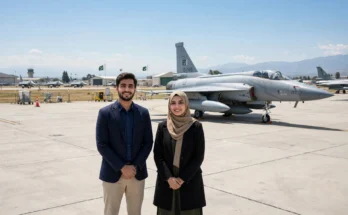
Navy medical jobs are health roles inside a naval force — doctors, dental surgeons, nurses, and medical technicians who care for sailors at naval hospitals, bases, and ships. In Pakistan, they come through the medical branch for officers, the sailor branch for female medical technicians, and civilian posts at naval hospitals.
Most career advice about these jobs is vague. It tells you to “join the navy” without saying which of the four separate entry routes fits your education — and a girl with Matric and a doctor with FCPS apply through completely different doors. This guide fixes that: every route, its exact eligibility, real salary figures from published sources, and the full selection process, so you can pick the right door before you apply.
What Are Navy Medical Jobs?
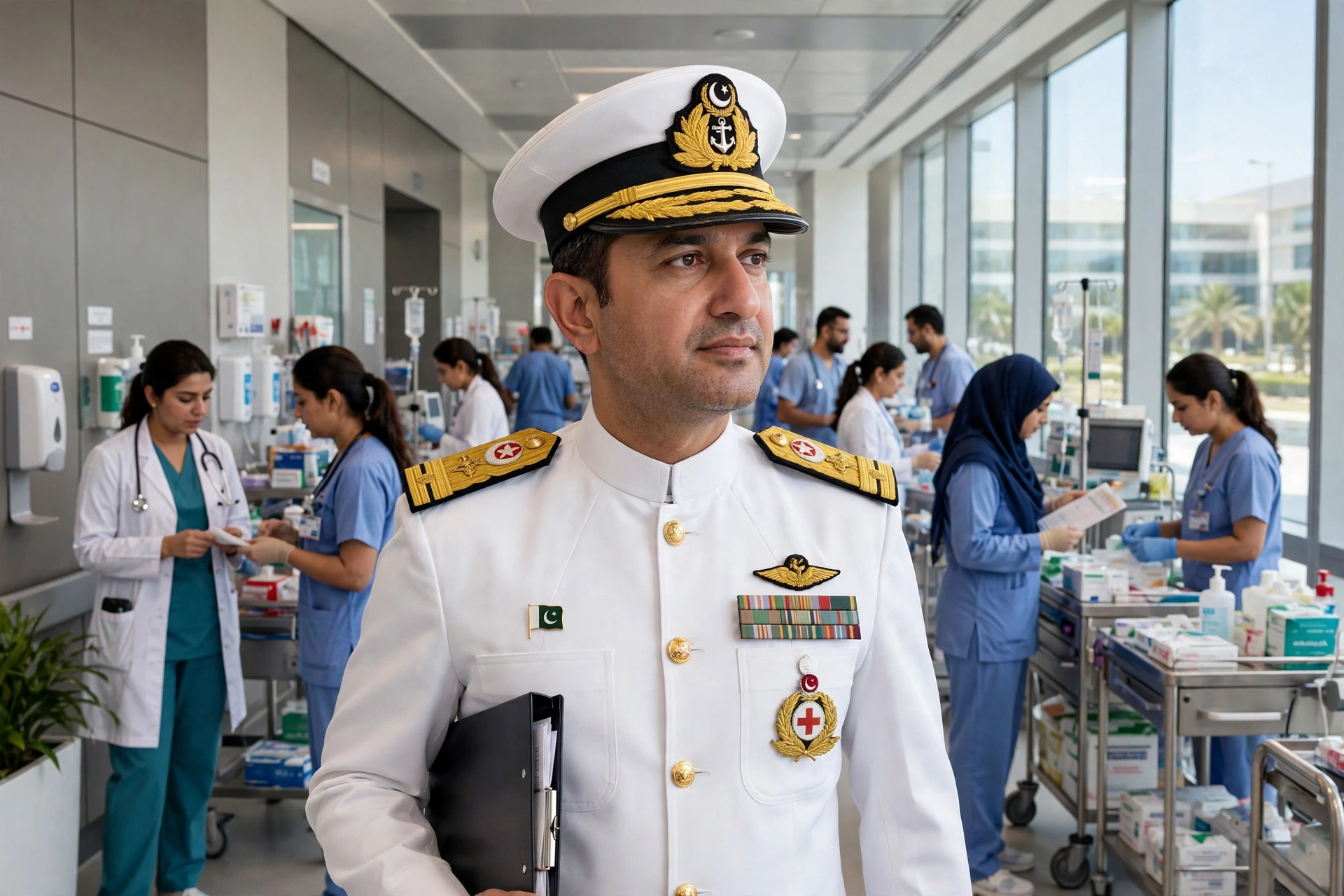
Navy medical jobs cover every healthcare role in a naval service. At the top sit commissioned medical officers — general duty medical officers (GDMOs) and specialists in fields like cardiology, surgery, anesthesia, and radiology. Below them work nursing officers, dental staff, and trained medical technicians who assist doctors, handle medicine, and keep patient records.
In Pakistan, navy medical jobs exist in three separate systems that do not overlap. First, the Pakistan Navy’s own medical branch takes doctors as commissioned officers through the Short Service Commission. Second, the sailor branch takes young women as Female Medical Technicians (FMTs) after Matric. Third, the Navy hires civilians — nurses, technicians, and medical officers — through its civilian intake (PNCA), and these civilians work at naval hospitals without wearing a uniform.
Most doctors serve at large naval hospitals, with PNS Shifa in Karachi being the best known. Medical officers also serve at base dispensaries and, on posting, aboard ships — a posting that civilian doctors never get. When I researched this guide, I found that most articles mix these three systems into one list, which is why so many candidates apply through the wrong channel. I have kept them separate here so you do not make that mistake.
The 4 Entry Routes for Navy Medical Jobs in Pakistan
Pakistan offers four distinct ways into navy medical jobs. Your education decides which one is open to you. The table below compares them side by side, using the criteria published in official recruitment advertisements.
| Entry route | Who it is for | Minimum education | Age limit | Gender |
|---|---|---|---|---|
| Medical branch officer (GDMO) | Doctors joining as commissioned officers | MBBS with one-year house job, registered with PM&DC | Up to 30 years | Male and female |
| Medical branch specialist | Experienced consultants | MBBS/BDS plus FCPS or equal foreign qualification in the specialty | Usually 40–42 years | Male and female |
| M-Cadet scheme | Medical students still studying | 4th or 5th year MBBS at a recognized college | NOT AVAILABLE in current ads | Male and female |
| Female Medical Technician (FMT) | Girls starting after school | Matric with Science (Biology), 65% marks | 16–20 years | Female only |
| Civilian medical staff (PNCA) | Nurses, technicians, doctors as civilians | Matric to MBBS depending on post | NOT AVAILABLE in current ads | Male and female |
GDMOs are the main officer intake. You need an MBBS recognized by the Pakistan Medical & Dental Council, a completed one-year house job, and valid PM&DC registration. On joining, a GDMO is commissioned as a Surgeon Lieutenant — the medical equivalent of a lieutenant’s rank. Specialists such as cardiologists, anesthetists, neurologists, and surgeons join at a higher acting rank, usually Acting Surgeon Lieutenant Commander, and most advertisements prefer about two years of experience in the field.
The M-Cadet scheme is the least known route. Medical students in their fourth or fifth year of MBBS at recognized colleges can apply while still studying, which locks in a naval career before graduation. For women who have just finished school, the FMT route is the most direct: one advertisement, Matric with Biology, and you enter as a uniformed sailor trained in medical support.
Q: What qualifications do I need for Pakistan Navy medical jobs?
A: It depends on the route. Doctors need an MBBS recognized by the PM&DC plus a completed one-year house job and valid registration to join as GDMO officers. Specialists need MBBS or BDS with an FCPS or equal foreign qualification. Female Medical Technicians need Matric with Science (Biology) and at least 65% marks. Civilian nurses and technicians are hired through the Navy’s civilian intake with qualifications ranging from Matric to MBBS.
Eligibility: Age, Education, Height, and Marital Status
Every route has its own age band, and missing it by a year ends the application. For officer medical branch entries, the published age limit for GDMOs is up to 30 years, while specialist posts usually accept candidates up to 40–42 years. Female Medical Technicians must be between 16 and 20 years old. Sailor and civilian ages are counted to a fixed date given in each advertisement, so check the current one before you apply.
Height and citizenship rules apply across the board. Male officer candidates need a minimum height of 5 feet 4 inches, and female candidates need 5 feet. Female Medical Technicians need at least 4 feet 8 inches (142 cm). Only Pakistani citizens can apply, and dual nationality holders must surrender their foreign nationality if selected. Most entries require unmarried candidates — the FMT branch is strictly unmarried females — with a few exceptions in civilian and senior posts.
Medical fitness is checked at naval hospitals or recruitment centers. Officers go through the ISSB selection system (tests, medical, and interviews by the Naval Selection Board), while sailors take computerized intelligence and academic tests at Pakistan Navy Recruitment & Selection Centres in cities including Karachi, Lahore, Rawalpindi, Peshawar, Quetta, Multan, Sukkur, Faisalabad, Hyderabad, and Gwadar. If you are comparing services, the Pakistan Army’s online application process follows a similar staged pattern, and the Lady Cadet Course is the Army’s equivalent entry for women officers.
Q: What is the age limit for navy medical jobs?
A: GDMO officers can apply up to 30 years of age, and specialists usually up to 40–42 years. Female Medical Technicians must be 16 to 20 years old. These limits are strict and counted to a date fixed in each advertisement, so a candidate who turns 21 before that date cannot apply for the FMT branch. Always check the current advertisement rather than relying on last year’s dates.
Salary, Ranks, and Benefits
Pay in navy medical jobs comes in three layers: basic salary, allowances, and benefits that civilians rarely get. For Female Medical Technicians, published sources put the starting salary at about PKR 35,000 to 45,000 per month before allowances, with extra payments for medical, house rent, and conveyance on top.
Here is a simple worked example using the higher published figure. A Female Medical Technician starting at PKR 45,000 per month earns:
45,000 × 12 = PKR 540,000 per year in basic pay, before any allowances.
That figure grows with annual increments, and the real value of the job sits in the benefits: free medical treatment for the sailor and her family at naval hospitals, free accommodation and meals during training, free uniform, pension after retirement, and concessionary travel. I would not trade those benefits for a slightly higher civilian salary, because the medical cover alone is worth a large sum over a career.
Civilian medical posts pay more in cash. In the Navy’s 2026 civilian intake, a nurse or technician at BPS-16 earns PKR 88,000–115,000 per month with a special health allowance, while a civilian Medical Officer at BPS-18 earns PKR 155,000–210,000 per month with a non-practicing allowance, official transport, and housing facility. Commissioned GDMO officers earn on the military pay scale with the rank of Surgeon Lieutenant and full officer privileges, though exact officer pay figures are not published in the advertisements I checked.
| Post | Monthly pay (published) | Key benefits |
|---|---|---|
| Female Medical Technician (sailor) | PKR 35,000–45,000 + allowances | Free family medical care, accommodation, pension |
| Civilian nurse/technician (BPS-16) | PKR 88,000–115,000 | Health allowance, pension plan |
| Civilian Medical Officer (BPS-18) | PKR 155,000–210,000 | Non-practicing allowance, transport, housing |
| GDMO officer (Surgeon Lieutenant) | Military scale — NOT AVAILABLE in published ads | Officer rank, full service benefits |
Q: How much do navy medical jobs pay?
A: Female Medical Technicians start around PKR 35,000–45,000 per month plus allowances, civilian nurses at BPS-16 earn PKR 88,000–115,000, and civilian medical officers at BPS-18 earn PKR 155,000–210,000. Commissioned doctors join as Surgeon Lieutenant on the military pay scale. Every role adds free medical care for the family, housing support, and pension — benefits that make the total package larger than the salary alone.
How to Apply for Pakistan Navy Medical Jobs
Registration for every route runs through the official portal at joinpaknavy.gov.pk. The Navy announces officer entries through the Short Service Commission course (usually twice a year) and sailor entries in batches such as the A-2026 (S) batch. Here is the full process in order:
- Register online at joinpaknavy.gov.pk during the announced dates and note your roll number.
- Appear for the computerized initial test at your chosen recruitment center — intelligence plus academic subjects.
- Clear the preliminary medical examination at the center or a naval hospital.
- Complete the personality assessment (sentence completion, picture stories, interviews).
- Face the final interview — the Naval Selection Board for officers, the selection board for sailors.
- Wait for the merit list and the final call letter.
After final selection, training begins before you start real duties. Commissioned medical officers complete military training and are then commissioned at their rank, while Female Medical Technicians complete naval training followed by medical trade training at naval establishments. The exact training length is set per course in the joining instructions.
Officer candidates additionally pass through ISSB testing. When I mapped this process, I noticed candidates lose the most time at step one: they wait for a friend to confirm the dates instead of checking the portal. The portal is the only source that matters. If your course is not announced there, no agent or academy can get you in. Candidates interested in other federal uniformed careers can also read our guide to FIA Jobs 2026.
Q: How do I apply for navy medical jobs?
A: Register online at joinpaknavy.gov.pk when your course or batch is announced, then clear the computerized intelligence and academic tests, the preliminary medical, the personality assessment, and the final interview by the Naval Selection Board. Officer candidates also go through ISSB testing. Check the portal yourself for dates — academies cannot enroll you if the course is not announced.
What the Selection Tests Look Like
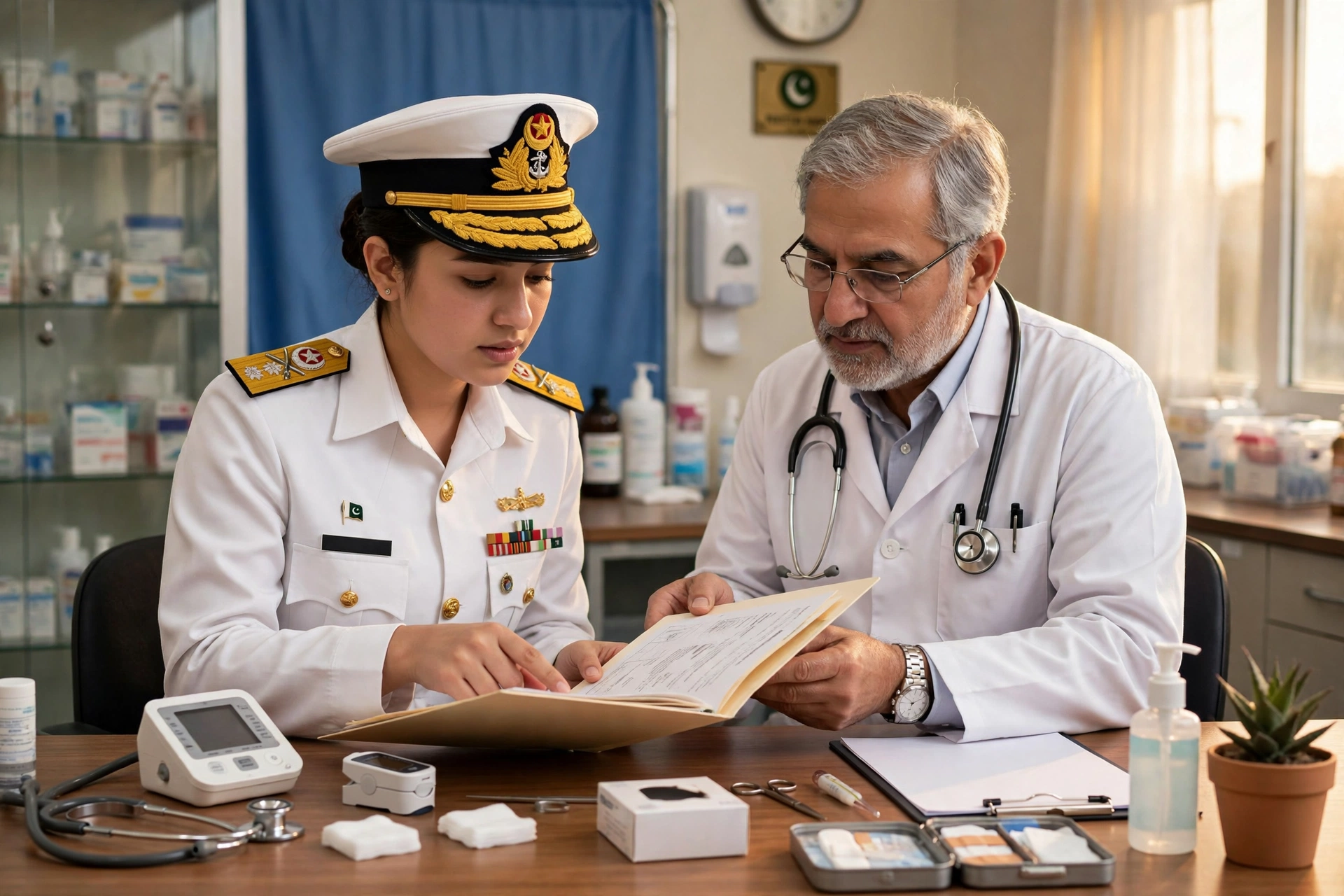
The selection tests are computerized intelligence and academic MCQs for sailors, with extra ISSB stages for officer candidates. Knowing the test pattern before you walk in is the single biggest advantage you can give yourself. For the Female Medical Technician entry, the published pattern is exact: an intelligence test of 40 MCQs in 18 minutes, followed by an academic test of 40 MCQs in 18 minutes covering English, Physics, Chemistry, Biology, Mathematics, Islamic Studies, and General Knowledge.
Do the maths on the timing. Eighteen minutes is 1,080 seconds, divided by 40 questions:
1,080 ÷ 40 = 27 seconds per question.
You have under half a minute per question, so practice with a timer or the paper will beat you. The academic test weights Biology, Chemistry, Physics, and Mathematics most heavily for medical branch candidates. For officer entries, the initial test follows the same intelligence-plus-academic shape, then ISSB adds group tasks, psychological assessment, and a final board interview.
Physical standards are checked alongside. Sailors must meet the height and fitness criteria at the recruitment center, and officers complete the standard armed forces medical examination. Candidates rejected twice by the ISSB for the same course type become ineligible, so treat every attempt as if it is your last — because for that entry, it might be.
Navy Medical Jobs Outside Pakistan
Navy medical jobs exist in almost every major navy, and comparing them shows what is genuinely different about the Pakistani system. The Royal Navy publishes its figures openly: a Medical Assistant starts at over £26,334 and can rise past £64,866, a Nursing Officer rises to at least £35,800 during training, and a Medical Officer starts at £76,100 from day one. Entry ages run from 17.5 to 39, and ratings can join with GCSE-level qualifications — a much lower academic bar than Pakistan’s officer route.
The United States Navy runs the famous Hospital Corpsman program, where enlisted sailors train as medics and serve with Marine units — a role closer to Pakistan’s FMT than to its GDMO officers. The real difference is transparency: foreign navies publish exact pay bands, while Pakistan’s officer pay stays inside the military scale. If you are a Pakistani doctor weighing a naval career against private practice, that missing public number is the one fact I could not verify. Everything else in this guide comes from published advertisements.
How I worked out the figures in this guide: I took every number from published recruitment advertisements and official navy career pages, and I show the maths in full wherever I combine two figures into a new one.
Q: Can females join the navy in medical jobs?
A: Yes, and medicine is one of the widest doors for women in the Pakistan Navy. Female doctors join as GDMO officers and specialists through the Short Service Commission, medical students can enter through the M-Cadet scheme, and girls with Matric (Science, Biology, 65%) can join as Female Medical Technicians — a uniformed sailor role with medical training. Female candidates must be unmarried and meet the height minimum of 4 feet 8 inches for the technician route.

The Short Version
Navy medical jobs in Pakistan come through four routes: GDMO officer (MBBS, up to 30 years, Surgeon Lieutenant rank), specialist officer (FCPS, up to 40–42 years), M-Cadet (4th/5th year MBBS students), and Female Medical Technician (Matric with Biology, 16–20 years, female only). Starting pay runs from about PKR 35,000–45,000 per month for technicians to PKR 155,000–210,000 for civilian medical officers, with free family healthcare and pension on top. Apply only through joinpaknavy.gov.pk, prepare for 27-seconds-per-question tests, and check the current advertisement for exact dates.
Frequently Asked Questions
Q: How do I apply for navy medical jobs in Pakistan?
A: Register online at joinpaknavy.gov.pk when your course or batch is announced. Then clear the computerized intelligence and academic tests, the preliminary medical, the personality assessment, and the final interview by the Naval Selection Board. Officer candidates also go through ISSB.
Q: What is the salary of a Female Medical Technician in the Pakistan Navy?
A: Published sources put the starting salary at about PKR 35,000–45,000 per month plus allowances for medical, house rent, and conveyance. On top of salary come free medical treatment for the family at naval hospitals, free accommodation during training, free uniform, pension, and travel concessions.
Q: Can a doctor join the Pakistan Navy after MBBS?
A: Yes. Doctors with an MBBS recognized by the PM&DC, a completed one-year house job, and valid registration can join as General Duty Medical Officers through the Short Service Commission, up to 30 years of age. The entry rank is Surgeon Lieutenant.
Q: What is the height requirement for navy medical jobs?
A: Male officer candidates need at least 5 feet 4 inches and female officer candidates at least 5 feet. Female Medical Technicians need a minimum of 4 feet 8 inches (142 cm).
Q: Are navy medical jobs open to civilians?
A: Yes. The Navy hires civilian nurses, technicians, and medical officers through its civilian intake (PNCA). These staff work at naval hospitals without a uniform — for example, a BPS-16 nurse earns PKR 88,000–115,000 per month and a BPS-18 medical officer earns PKR 155,000–210,000.